Curated Works & Antiques
A selection of authenticated objects, fine art, and period furniture from The Wiske Collection available for acquisition or study.
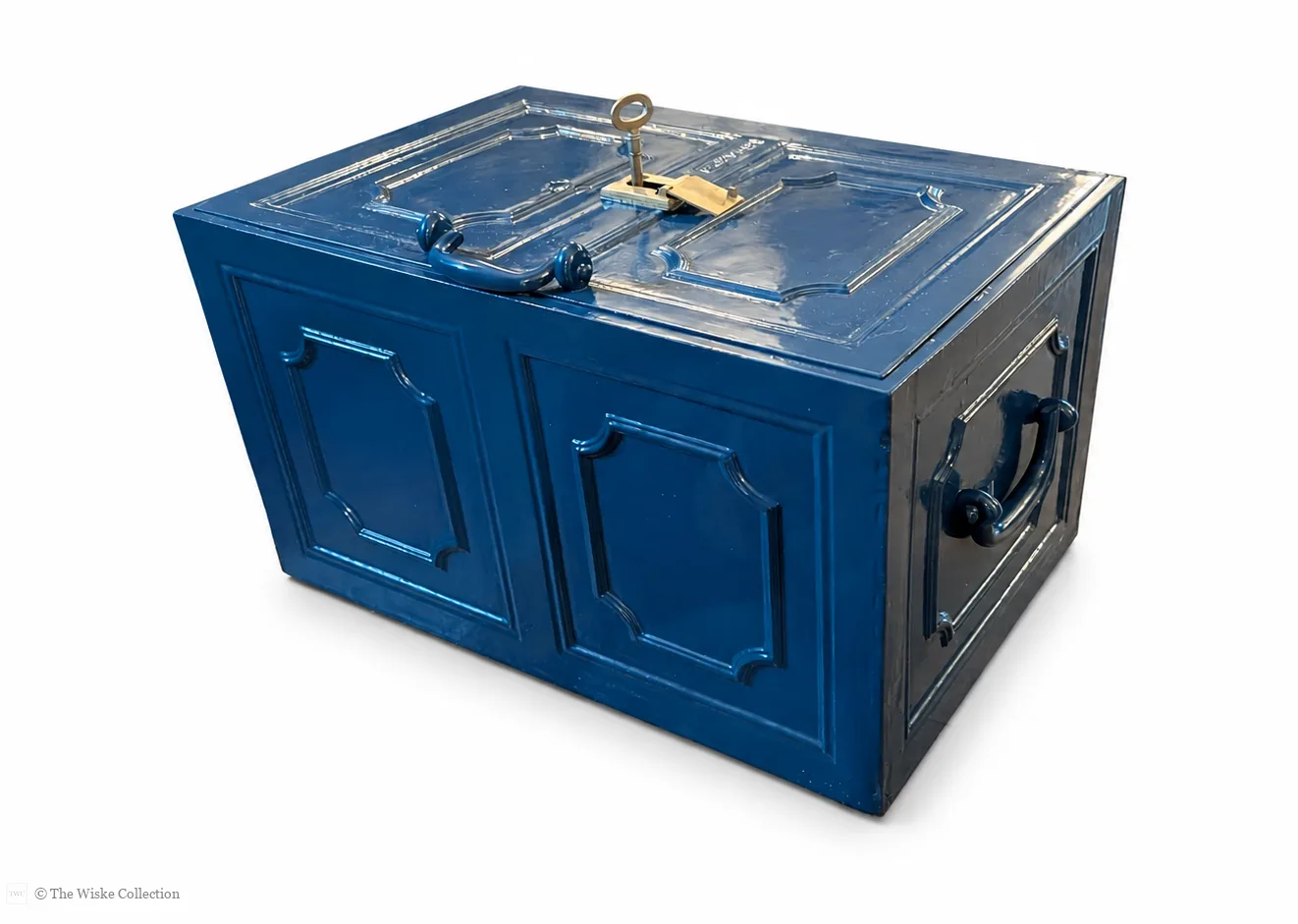
Victorian cast-iron strongbox by the Carron Company, Scotland, late 19th century, retaining its original brass lock and key
A late 19th-century Victorian cast-iron strongbox by the Carron Company, Scotland, of compact rectangular proportions and practical weight. The piece retains its original brass lock and key, the crisply cast carcass now presented with a professionally refinished painted exterior that contrasts with the undisturbed interior patina. At once utilitarian and visually assertive, it exemplifies the period’s industrial aesthetic, combining engineered solidity with a restrained, functional elegance. The strongbox’s manageable domestic scale and robust construction would have suited secure storage of documents and small valuables. Its preserved working components and balanced surface character recommend it as both a functional security object and an instructive example of late Victorian ironfounding from a leading Scottish manufactory.
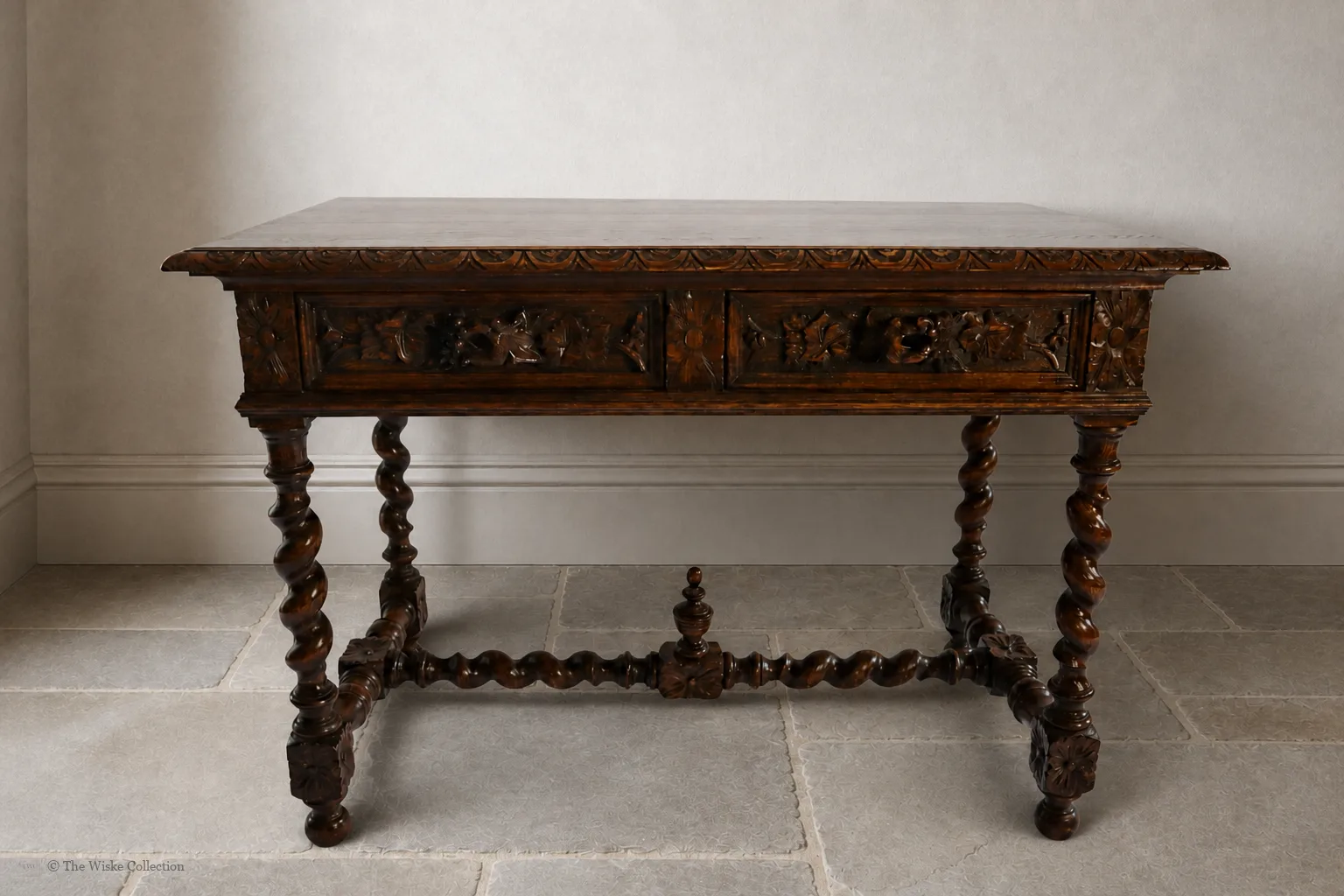
Victorian carved oak side table with solid moulded and carved rectangular top, deep frieze of foliate-carved twin drawers flanking a central panel, on barley-twist legs united by a shaped stretcher with turned knop, ending in block feet
A robust Victorian carved oak side table of Jacobean Revival character, the solid rectangular top enclosed by a moulded and leaf-carved border above a deep frieze configured with two foliate-carved drawer fronts flanking a central fixed panel. The support is provided by four boldly barley-twist legs united by a shaped stretcher centred by a turned knop and resting on block feet. Combining utility with decorative presence, the table’s emphatic turnings and carved ornament animate an otherwise rectilinear form. Well-proportioned and of practical scale, it would have served as a versatile ancillary surface while projecting a consciously historicising aesthetic typical of late 19th-century taste.
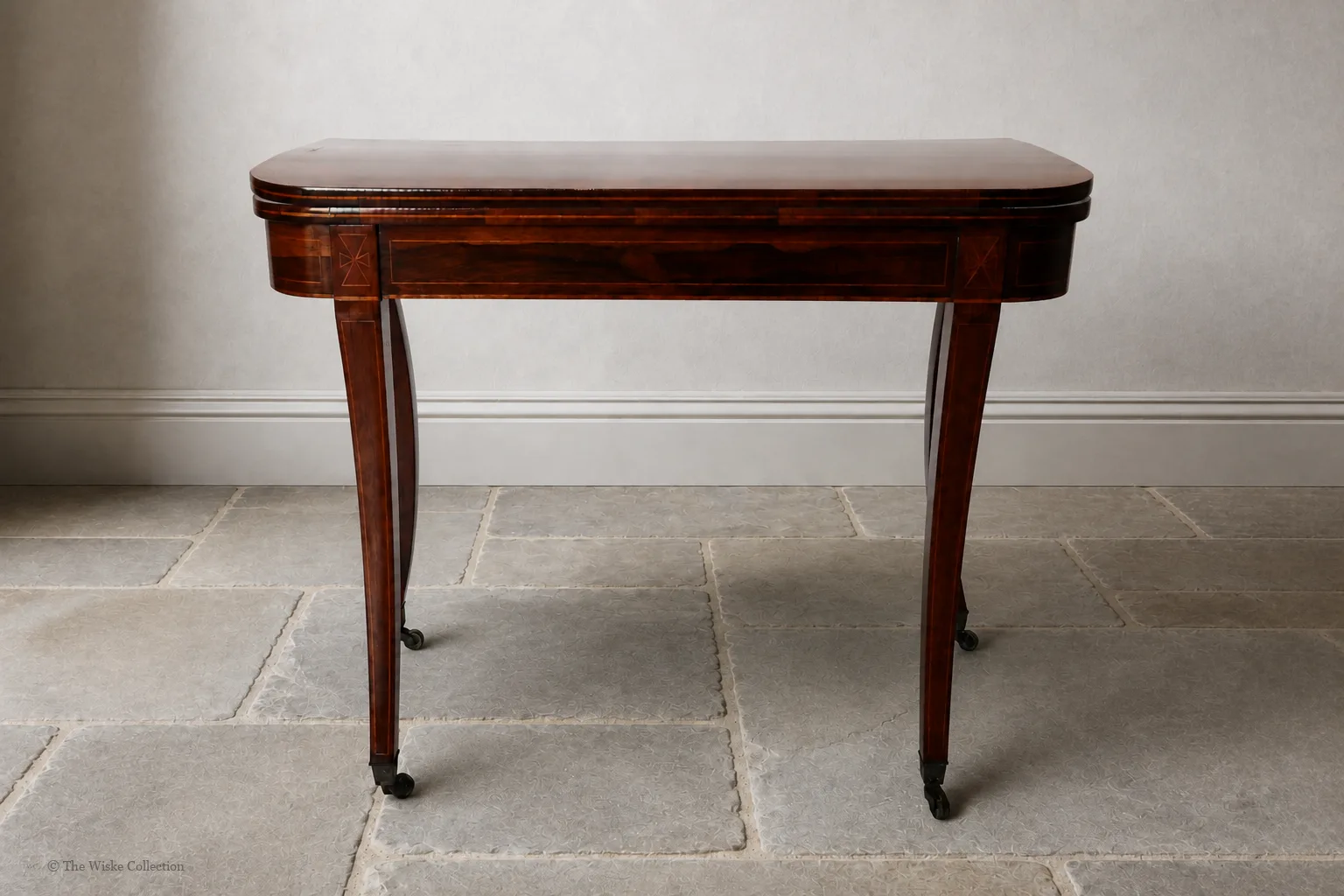
Beautiful Regency rosewood folding tea table, early 19th century, rounded rectangular top with satinwood banding and crossbanded frieze; hinged fold-over action; raised on tapered square supports with brass castors
An early 19th-century folding tea table in rosewood, the rounded rectangular top defined by satinwood banding and a neatly crossbanded frieze. Conceived for compact elegance, the hinged fold-over action allows the top to double in size for service, then return to a discreet console-like profile. The table is raised on tapered square supports terminating in brass castors, combining refinement with practical mobility. The restrained ornament, contrasting veneers, and clean geometry suggest a tasteful, neoclassically inflected aesthetic of the period. Well-proportioned and versatile, this example typifies the polite domestic ritual of tea, marrying surface richness in fine veneers with economical, well-resolved construction.
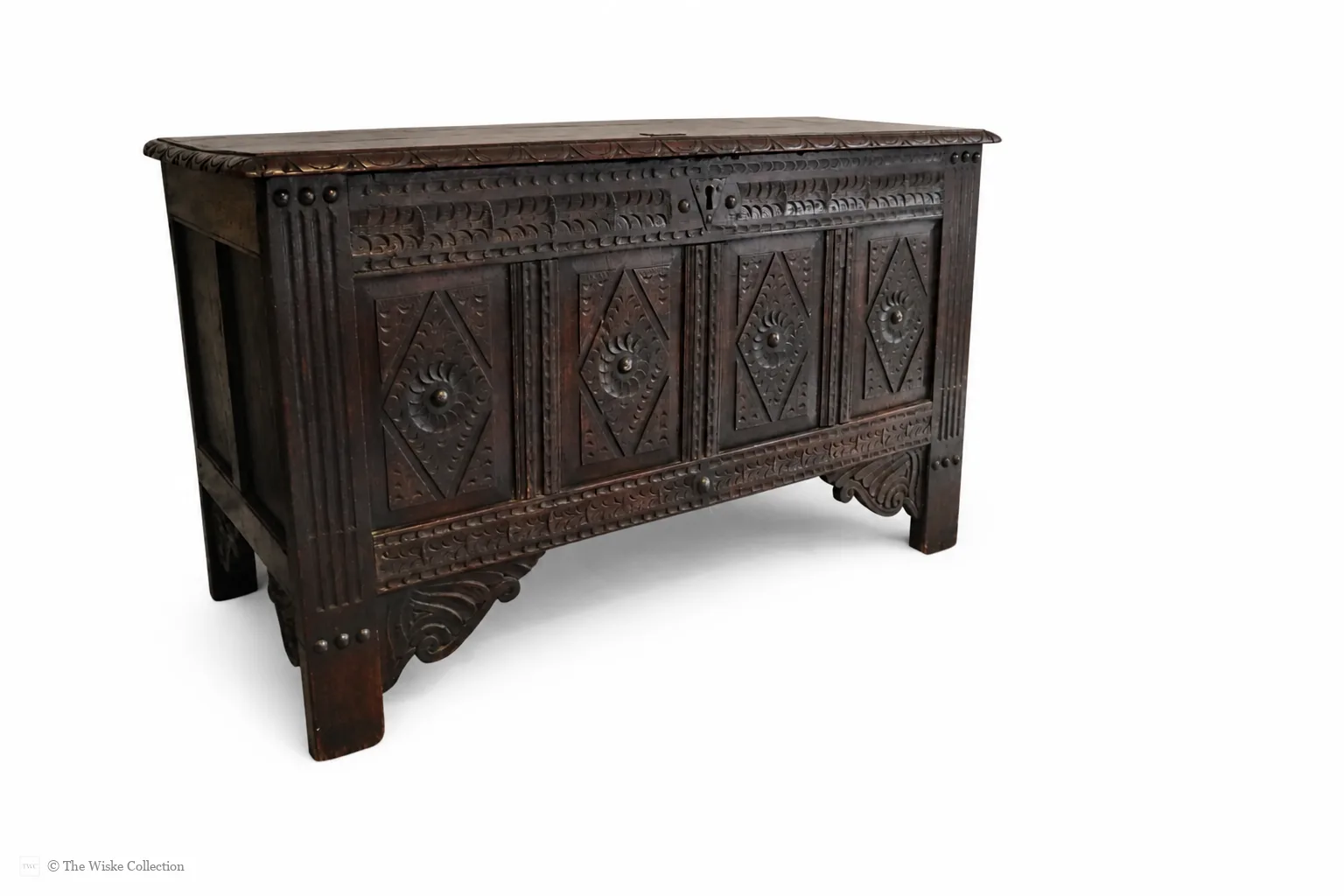
19th-century carved oak coffer; rectangular plank top over a four-panel front with lozenge and flowerhead carving, shaped lower apron, stile feet; sturdy provincial work
A robust 19th-century carved oak coffer of rectangular form, the thick plank top set above a four-panel front crisply carved with alternating lozenges and flowerhead motifs. The façade is anchored by a shaped lower apron and continues into integral stile feet, lending a grounded, architectural stance. The restrained geometry of the carving evokes 17th-century vernacular prototypes while remaining sober and well-balanced. At 118 cm in width, the piece offers practical storage and a useful horizontal surface, its clean lines and substantial timbers presenting the natural character of the oak to good effect. An appealing example of revivalist taste executed with durable, workmanlike construction.
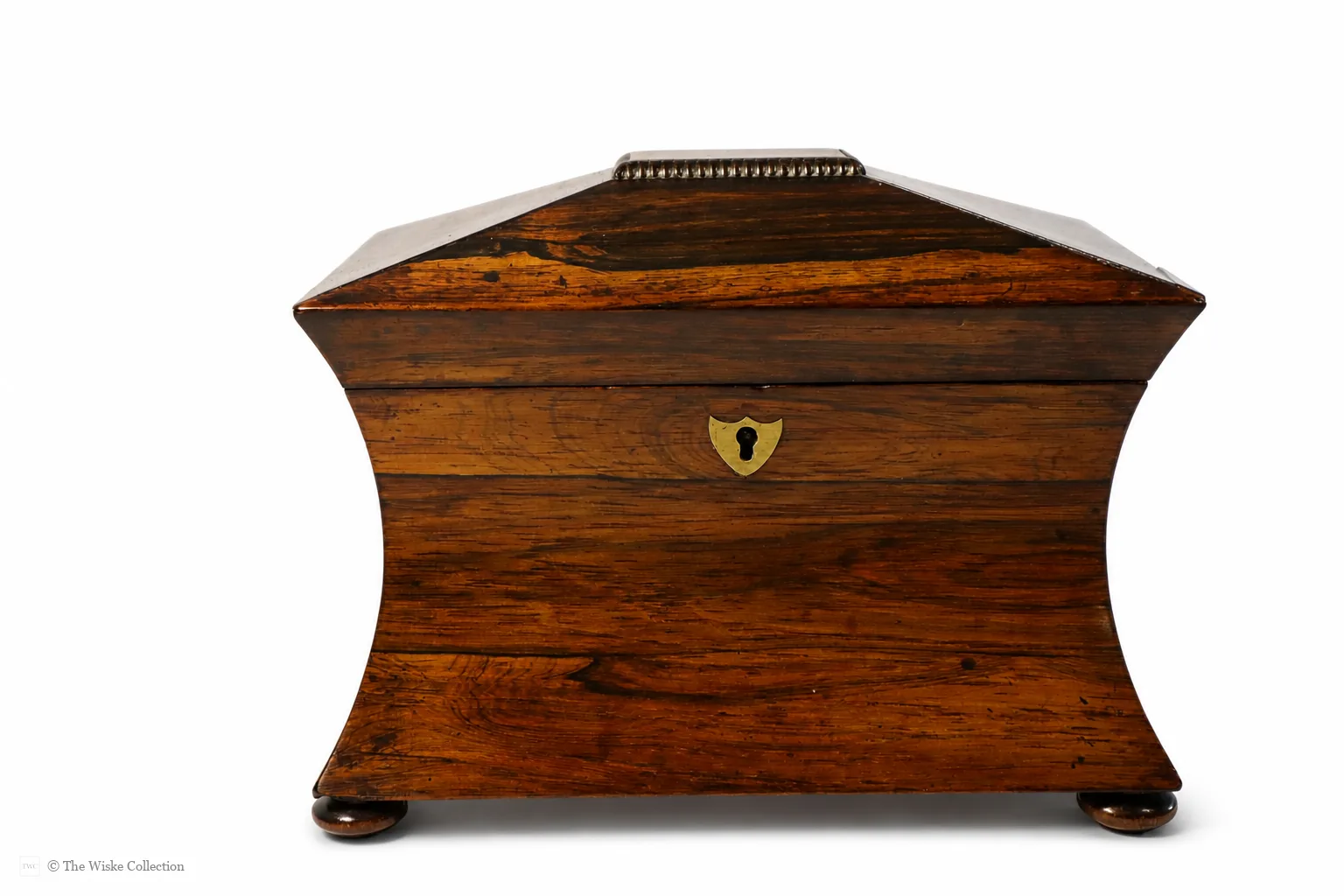
Early 19th-century rosewood tea caddy of waisted sarcophagus form, with twin compartments, brass keyplate, and compressed bun feet; 17cm high, 22cm wide
Early 19th century rosewood tea caddy of waisted sarcophagus form, the rectangular lid rising above a gently concave body and resting on four compressed bun feet. The exterior is understated and refined, with the warm figure of the rosewood uninterrupted save for a neatly set brass keyplate to the front. The interior, arranged with twin compartments, reflects the period convention of storing different teas separately. Of compact, table-top scale (approximately H 17cm, W 22cm), the piece combines classical taste with practical function, its poised proportions and crisp outline characteristic of the era’s disciplined aesthetic. A finely made domestic container expressive of the social importance of tea in the early nineteenth century.
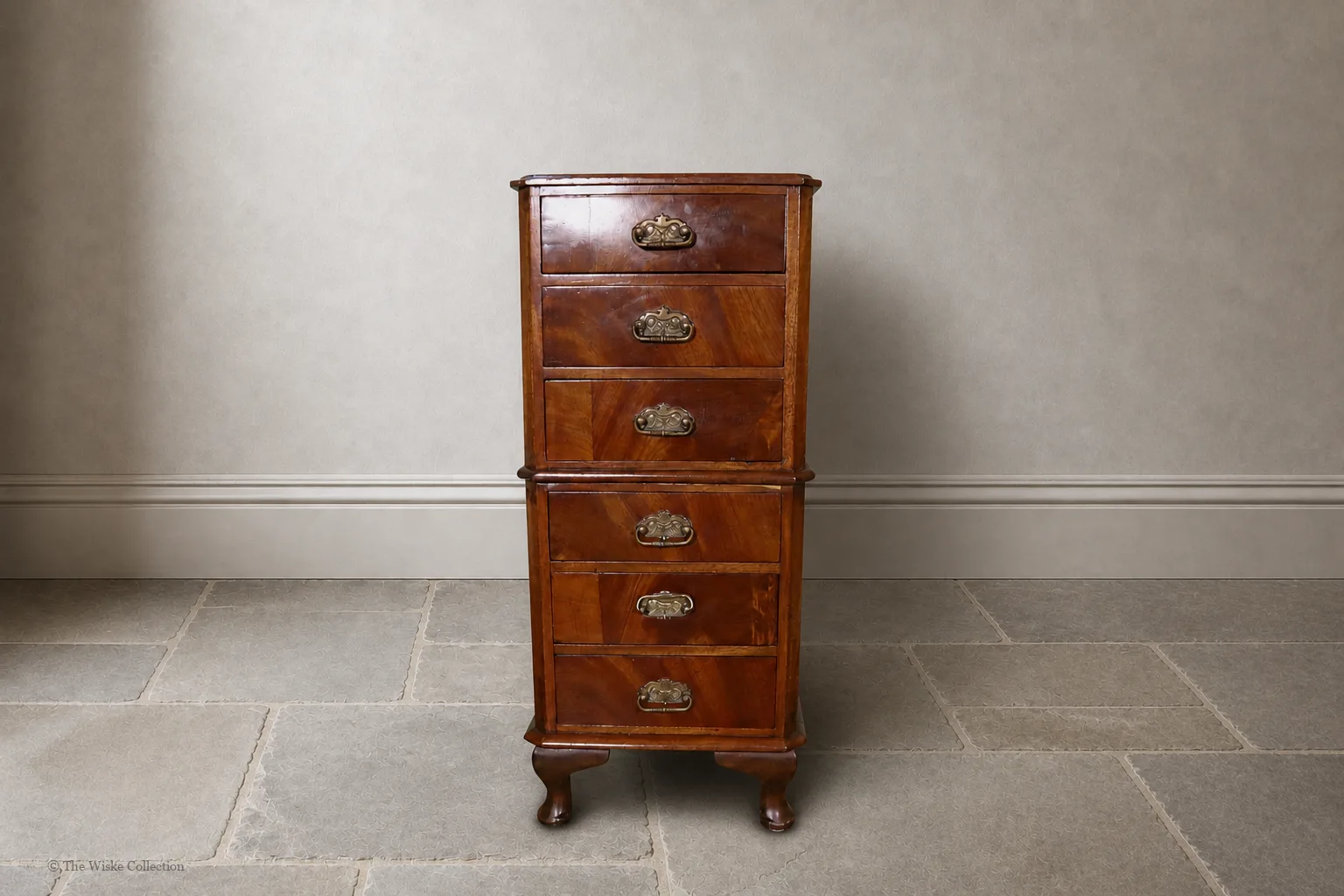
Early 20th-century walnut miniature chest of small proportions, with moulded rectangular top and clipped corners, six graduated drawers fitted with brass swing handles, and short cabriole feet; 67cm high, 28cm wide, 22cm deep
Compact early 20th-century walnut chest of drawers, of notably small proportions, the moulded rectangular top with clipped corners above six graduated drawers fitted with brass swing handles, and raised on short cabriole feet. The restrained geometry of the case is tempered by the sculptural stance of the feet and the softened profile of the top, yielding a piece that blends utility with an understated revival elegance. The vertical stack of finely graduated drawers maximises storage within a minimal footprint, making the chest particularly adaptable to intimate interiors or corridor settings. The use of walnut and brass imparts a warm, traditional character while the careful modulation of drawer sizes and the clipped-corner top signal a considered design derived from earlier 18th-century models.
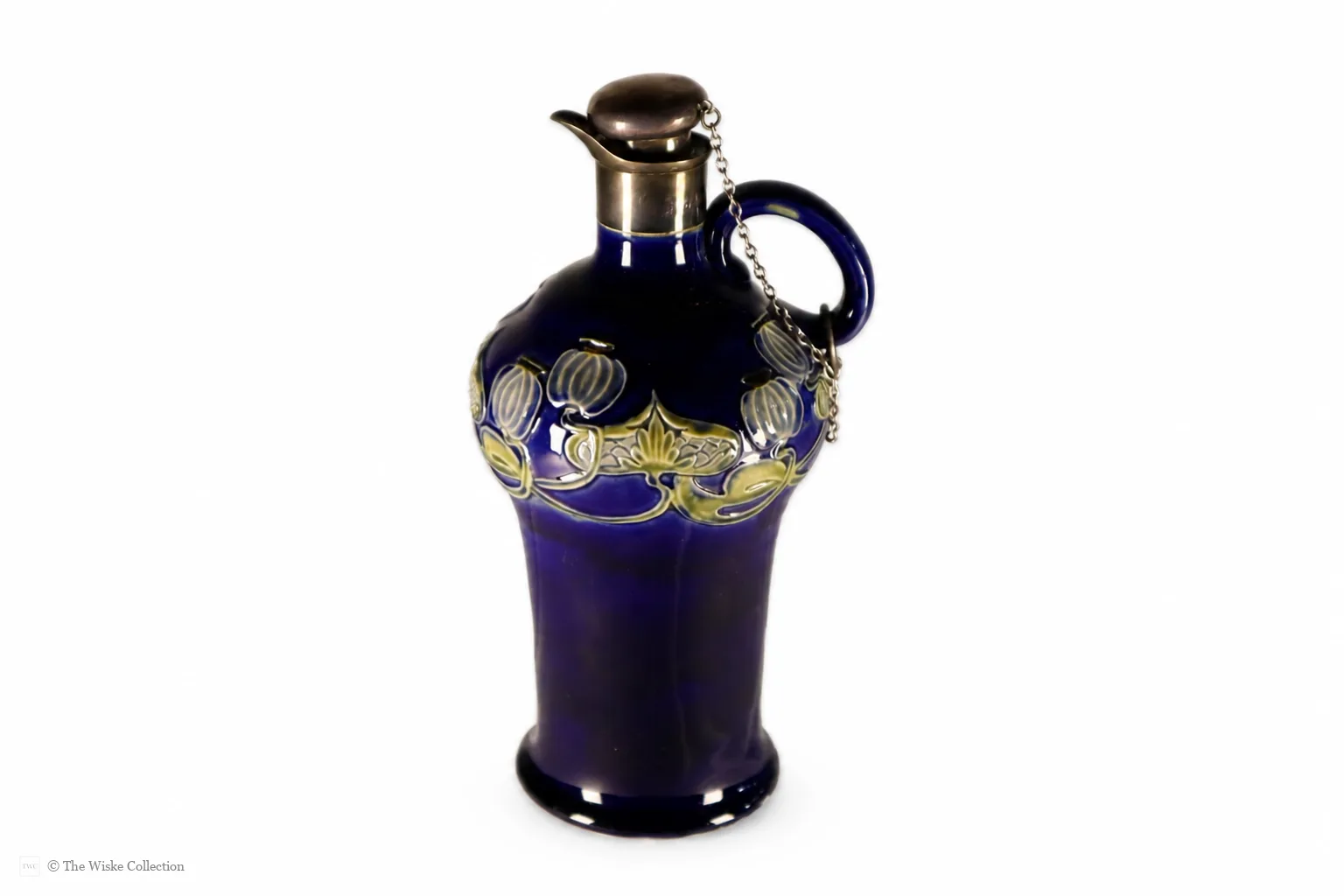
Edwardian Royal Doulton ceramic decanter by Marion Holbrook, of Art Nouveau design, with London 1903 silver collar and stopper; English origin, 23cm high
Royal Doulton Art Nouveau decanter, stated to be designed by Marion Holbrook, with a London 1903 silver-mounted collar and matching stopper. Of compact, elegant proportion at 23 cm high, the piece combines a refined vessel form with the soft dynamism characteristic of the period. The silver mount and stopper lend a polished accent to the flowing profile, exemplifying the integration of metalwork with ceramic wares at the turn of the twentieth century. The design aligns with contemporaneous Doulton output that privileged sinuous ornament and harmonious silhouette over overt historicism, while the London hallmark fixes the mounting to 1903. A representative object of early twentieth-century British decorative arts, it demonstrates the firm’s engagement with fashionable Art Nouveau idioms.
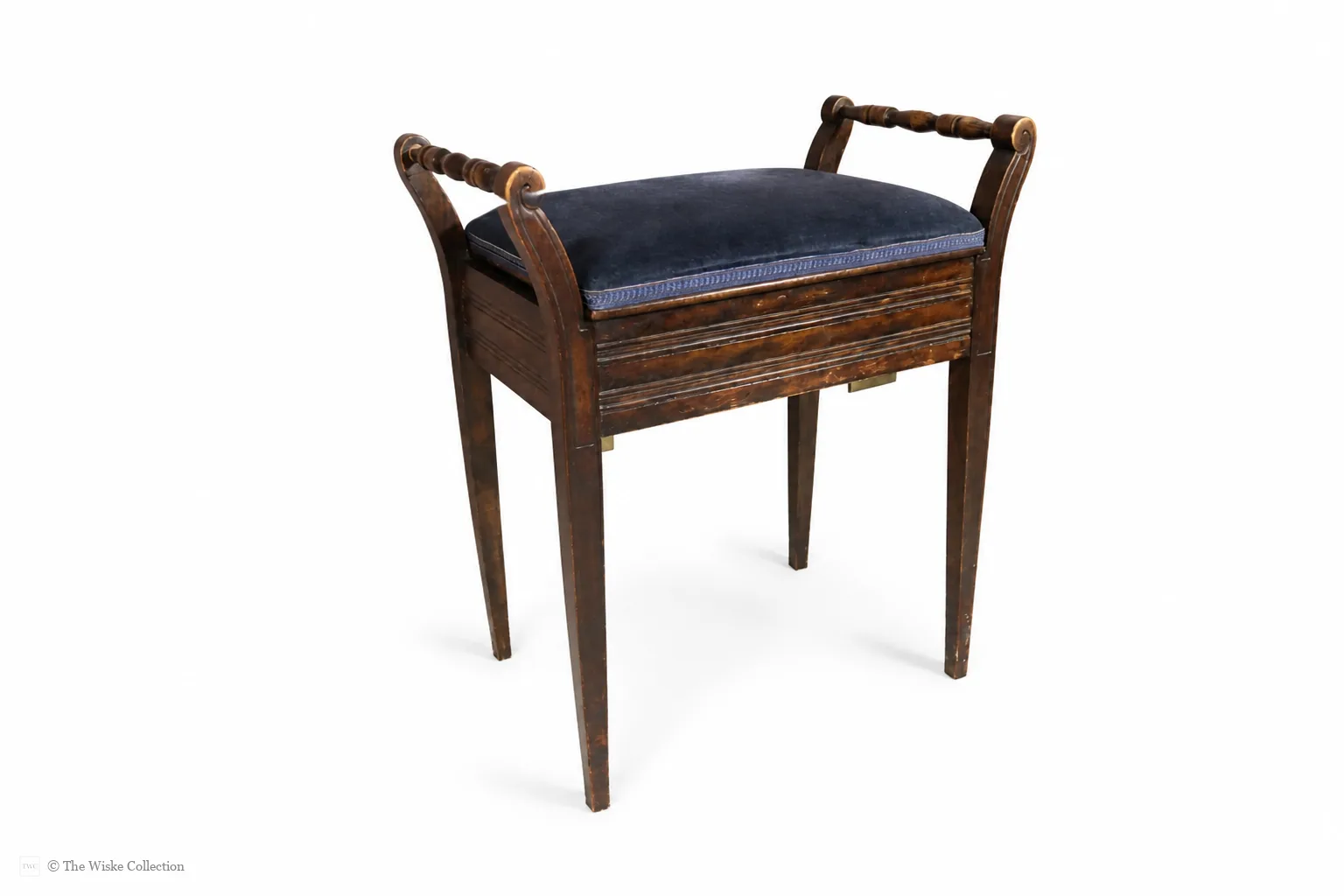
An Edwardian piano stool featuring a blue upholstered hinged seat, turned arms and tapering supports; wood frame with textile upholstery and metal hinges
An Edwardian piano stool of practical, compact proportions, the rectangular blue-upholstered seat hinged to the frame and flanked by short turned arms. The stool is raised on four tapering supports, imparting a light, upright stance suited to the domestic music room. The restrained turning and attenuated legs reflect the cleaner profiles favored in the early twentieth century, while the hinged seat underlines the design’s functional intent. At 54 cm high and 53 cm wide, it offers a stable, comfortable perch for use at piano or harmonium, the vivid upholstery lending a measured note of color against the wooden frame. A straightforward, serviceable example of Edwardian seating for musical use.
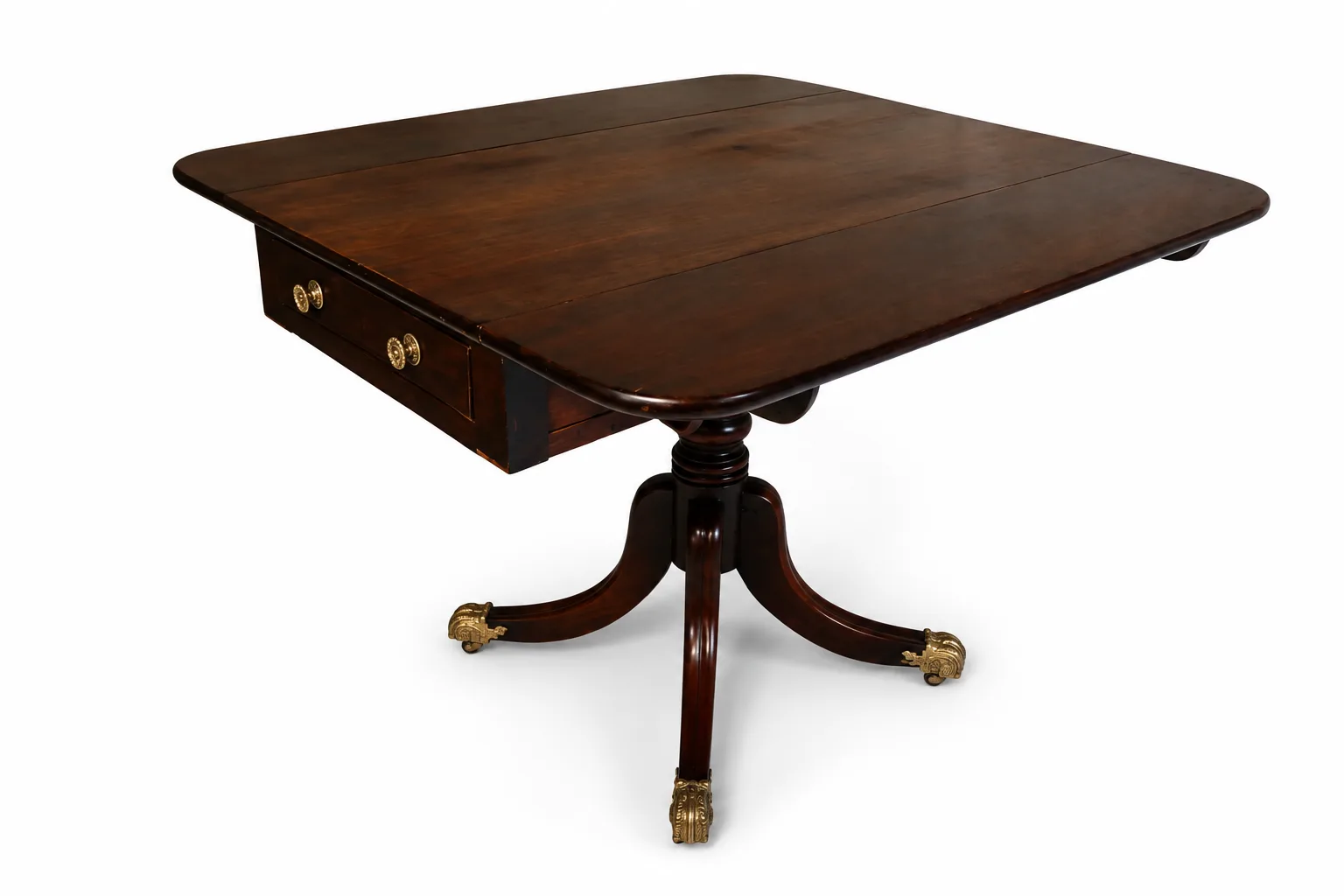
English late Regency mahogany drop-leaf Pembroke table, maker unknown, rectangular with rounded corners, frieze and blind drawers; raised on a turned pedestal with splayed legs ending in brass lion-paw feet and castors
A late Regency mahogany drop-leaf Pembroke table of practical, adaptable form, the rectangular top with rounded corners above a frieze drawer and a corresponding blind drawer creating a balanced façade. The top is supported on a well-turned pedestal column issuing four splayed legs terminating in brass lion paw feet with castors, combining poise with ease of movement. The restrained surface and refined silhouette are enlivened by the classical character of the paw feet, while the hinged leaves allow the table to serve as an occasional, tea, or small writing table as required. A concise, well-proportioned example exemplifying late Regency taste for clear geometry, polished mahogany, and bright brass accents.
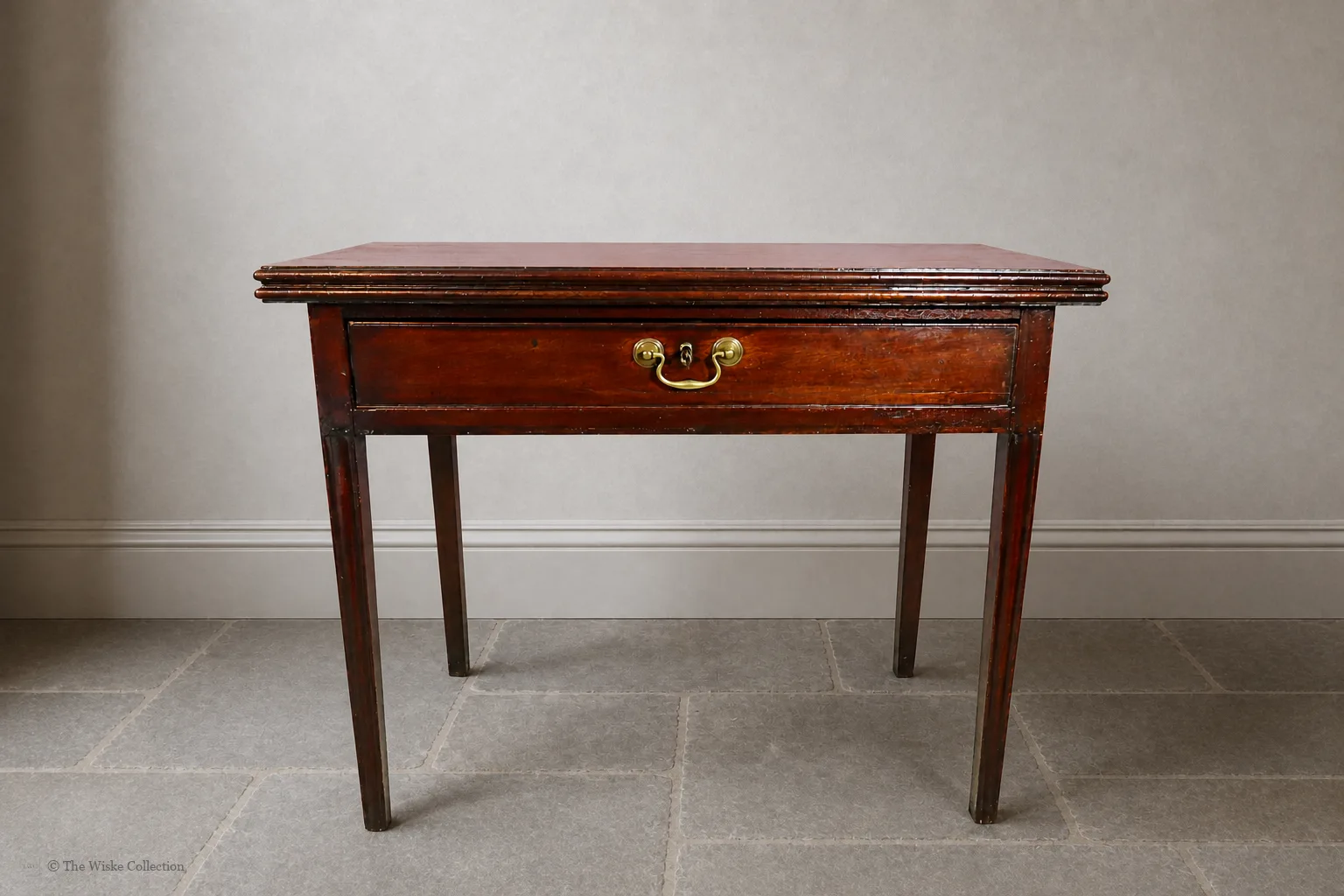
Georgian mahogany turnover-top tea table; rectangular hinged leaf unfolds to a square surface; single frieze drawer with brass swan-neck handle and escutcheon; square tapering legs
A Georgian mahogany turn-over top tea table of restrained, rectilinear character. The rectangular top folds over on hinges to form a square surface, the frieze incorporating a single drawer fitted with a brass swan-neck handle and matching escutcheon. Set on square tapering legs, the piece exhibits the quiet elegance associated with late eighteenth-century taste, favouring clean lines and balanced proportions. The dense, fine-grained mahogany presents a warm, even tone, while the brass mounts provide a modest accent. Practical in scale (H 74 × W 91 × D 48 cm closed), the table was designed to serve intimate tea service when opened and to read as a compact side table when closed, its discreet drawer addressing the storage of small implements.
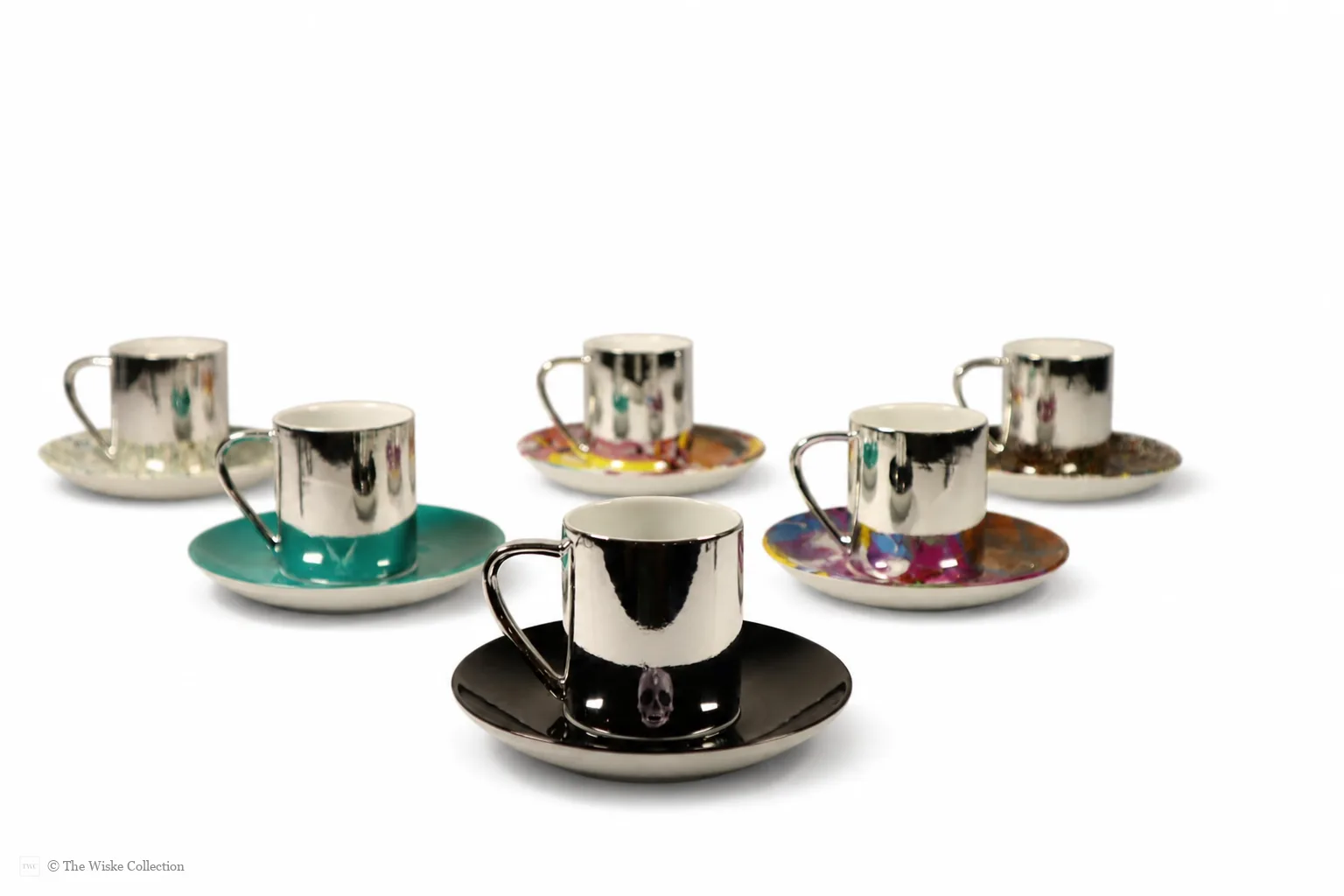
Damien Hirst (British 1965-); set of six anamorphic silver lustre espresso cups and saucers of various designs
Set of six espresso cups and saucers conceived by Damien Hirst (British, 1965–), each finished in a reflective silver lustre and bearing differing anamorphic designs. The suite aligns functional tableware with optical play, the mirror-like surfaces distorting and activating the imagery as the vessels are turned in the hand. The group, uniform in medium yet varied in decoration, exemplifies an artist’s multiple that merges contemporary conceptual concerns with domestic ritual. Presented as a cohesive set, the cups and saucers demonstrate a deliberate seriality and a cool, engineered visual language characteristic of late 20th- and early 21st-century design intersecting with contemporary art practice.
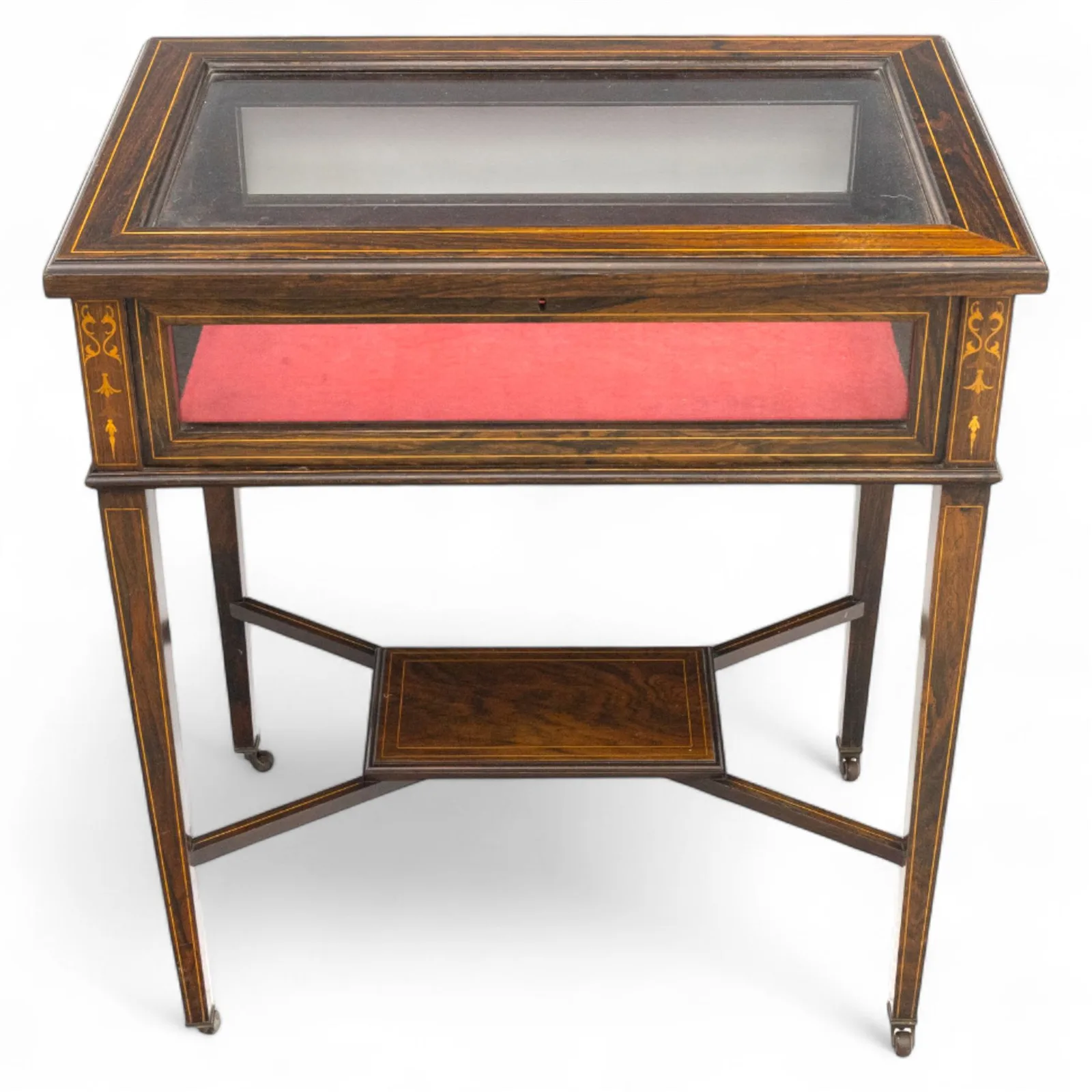
Edwardian rosewood bijouterie cabinet, the hinged rectangular top with line inlay enclosing a velvet lined interior, upon slender tapering legs inlaid with satinwood foliate marquetry decoration, with stretchers united by an under tier, raised on castors
An Edwardian rosewood bijouterie cabinet of refined, compact proportions, conceived as a light display table for personal treasures. The hinged rectangular top with line inlay opens to a velvet-lined interior, the carcase supported on slender tapering legs enriched with satinwood foliate marquetry. An undertier set within stretcher supports provides additional surface and contributes to overall rigidity, while discreet castors allow for ease of movement within an interior. The interplay of dark rosewood and pale satinwood stringing and marquetry evokes late eighteenth-century precedents, aligning the piece with the Sheraton Revival taste characteristic of the early twentieth century. A graceful, serviceable table for the drawing room or boudoir, combining delicacy of line with practical display and storage.
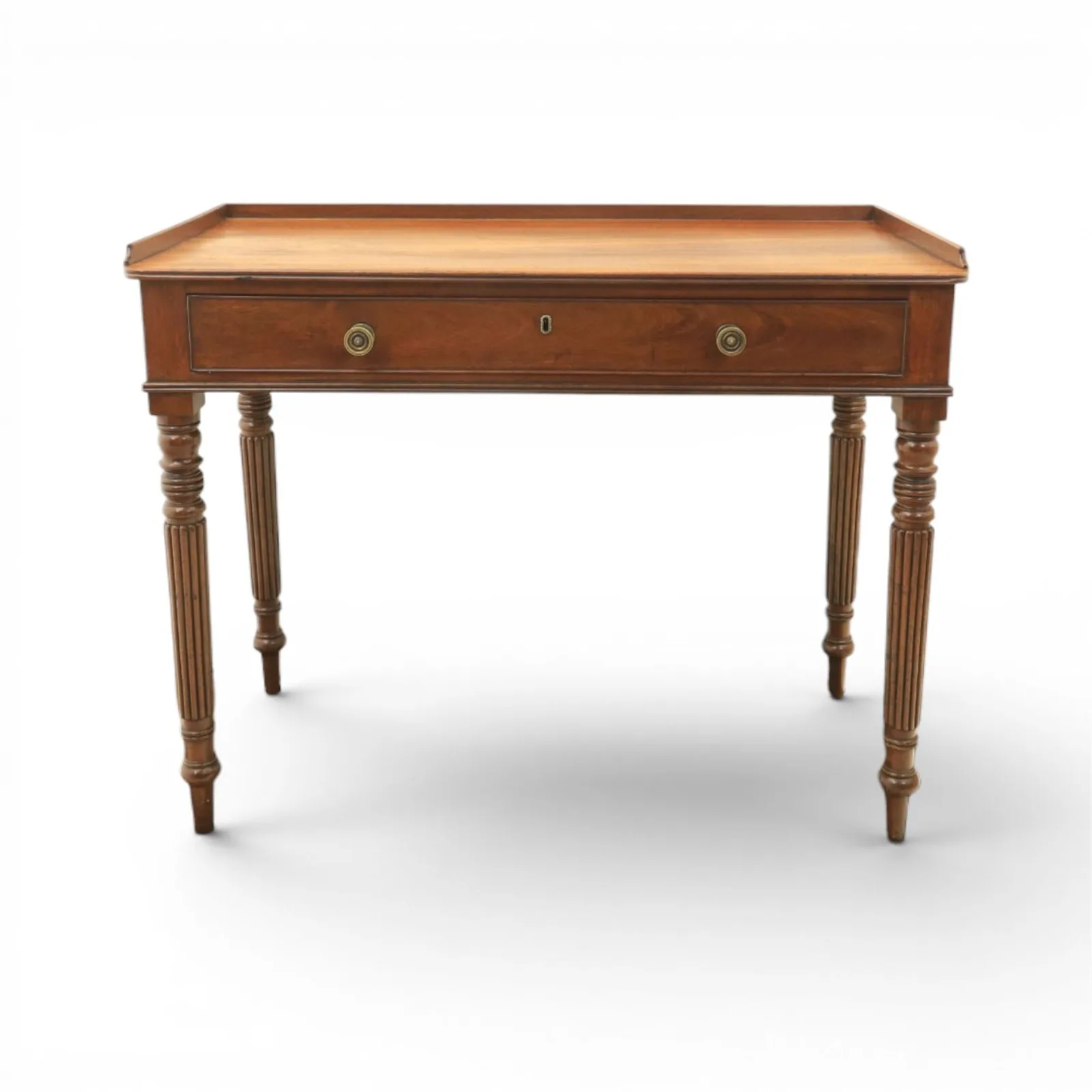
Regency English mahogany dressing table, stamped Gillow, early 19th century; rectangular top with three-quarter gallery above a frieze drawer with twin brass knobs; raised on turned and reeded supports
A refined early 19th-century mahogany dressing table bearing a stamped ‘Gillow’ mark, of compact, well-balanced proportions. The rectangular top is enclosed by a three-quarter gallery, practical for retaining toilette implements, above a plain frieze fitted with a single drawer and two original-type brass knobs. The table stands on four elegantly turned and reeded supports that speak to the restrained neoclassical taste of the Regency period. The piece combines utility with quiet sophistication, its crisp outlines and disciplined ornament indicative of high-quality cabinet work. The well-judged scale and disciplined detailing make it particularly suitable for bedchamber or dressing-room use while remaining versatile within a broader domestic interior.
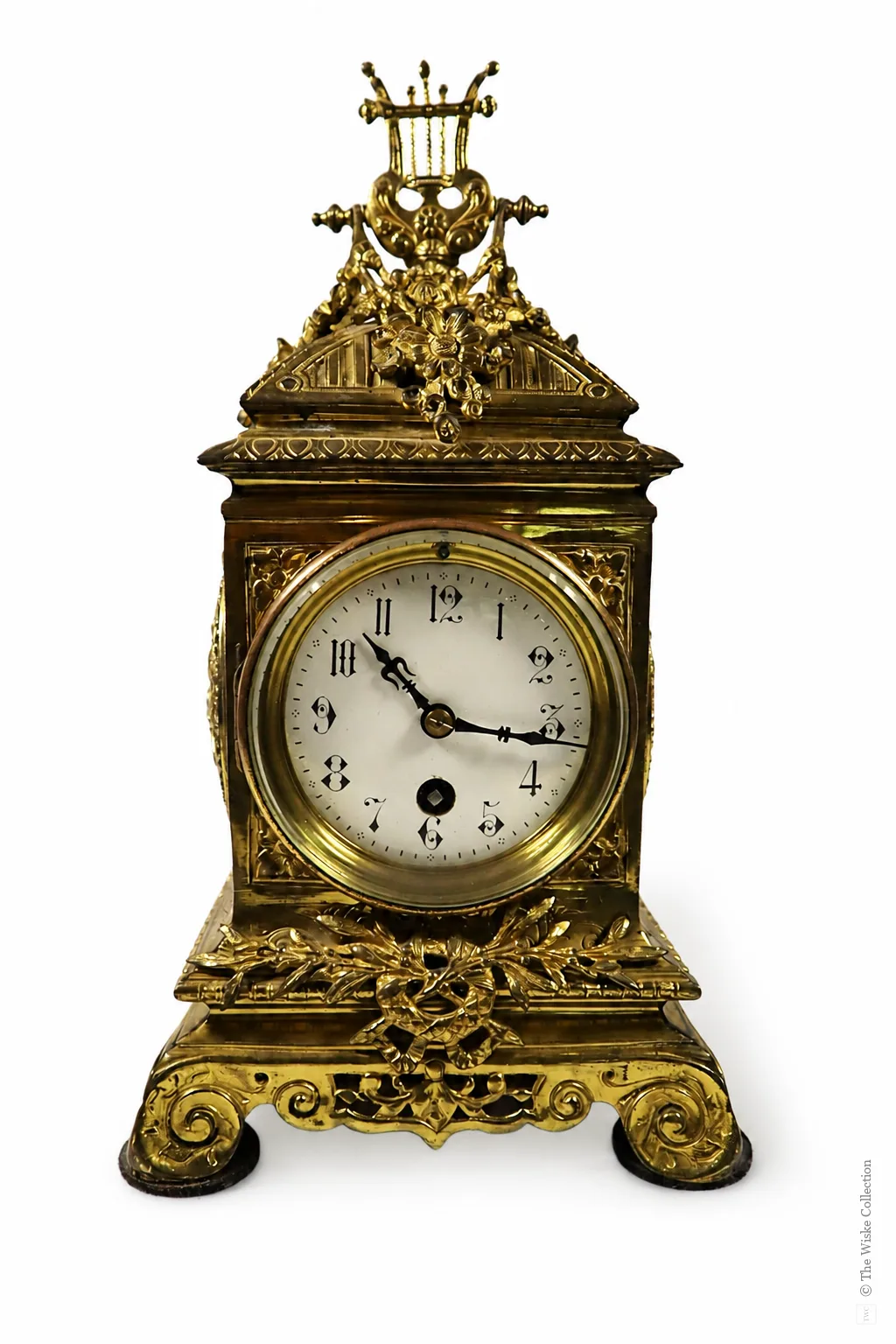
Early 20th-century Neoclassical brass mantel clock with white enamel dial, French timepiece movement and recoil anchor escapement; case crowned by lyre finial, trailing garlands and wreaths, on scroll feet
Compact early 20th-century mantel clock housing a French timepiece movement with a recoil anchor escapement, the white enamel dial set within a brass case enriched with revivalist ornament. The case is surmounted by a lyre finial and embellished with trailing garlands and laurel wreaths, all raised on shaped scroll feet. At approximately 30 cm high, the clock presents a well-composed vertical silhouette suitable for a mantel or bracket. The restrained dial contrasts pleasingly with the decorative brass, aligning function with display. The ensemble reflects a Neoclassical Revival sensibility popular in the period, balancing crisp, stylised motifs with practical, reliable horology. Provenance noted in the auction catalogue as property of a Nobleman.
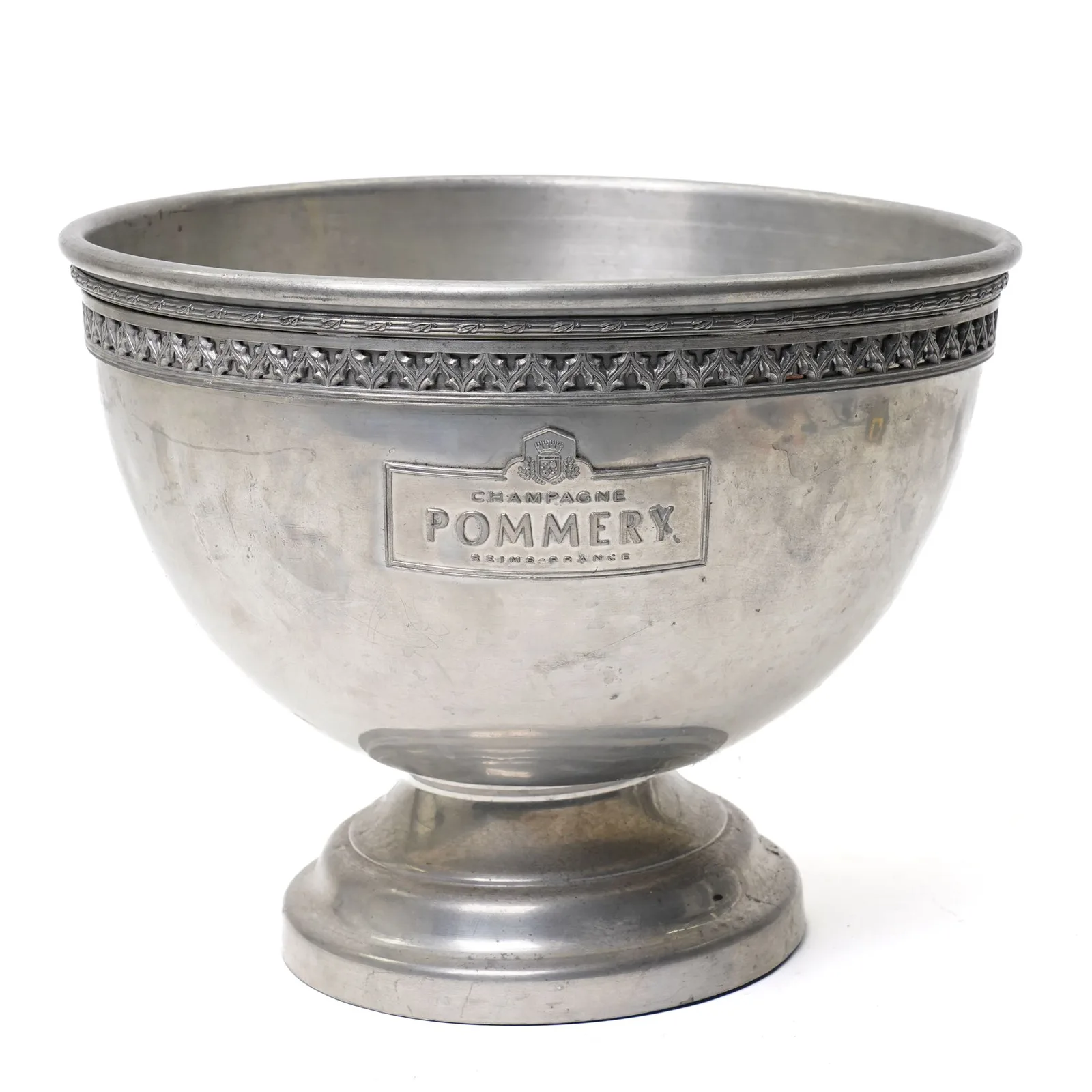
French Pommery champagne bucket of generous scale, H26
A French Pommery champagne bucket of generous, service-ready scale, measuring approximately 26.5 cm in height and 32 cm in diameter. Conceived for the chilling and presentation of Champagne at table or bar, the vessel communicates its purpose through a direct, functional profile while asserting brand identity through the association with the Pommery house of Reims. The capacious diameter indicates ample capacity for ice and water alongside the bottle, suitable for professional hospitality or refined domestic entertaining. Unencumbered by overt ornament, the bucket’s clarity of form and clearly legible branding place it within the tradition of twentieth-century commercial barware used by hotels, restaurants, and wine merchants to promote notable Champagne houses.
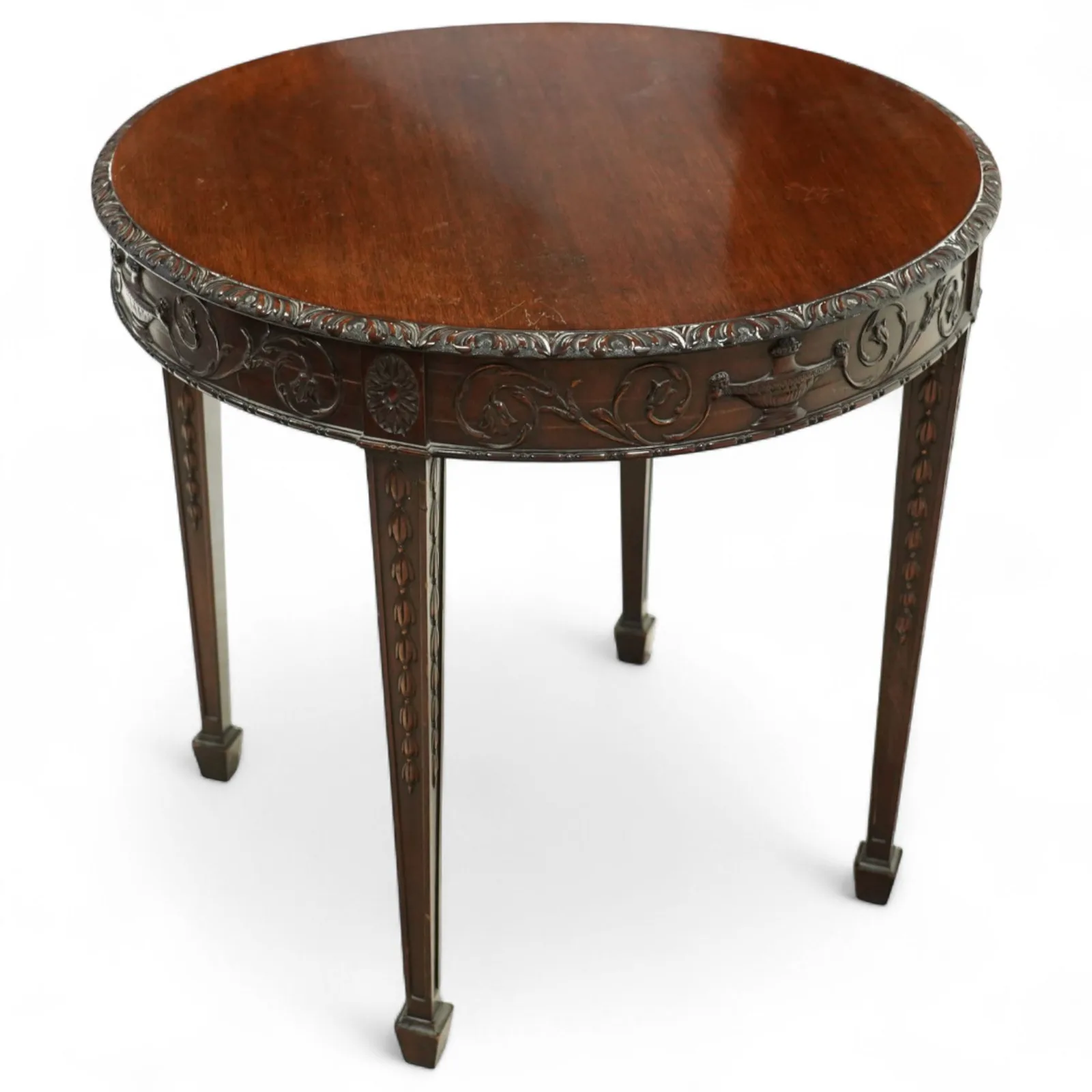
Early 20th-century Adam style mahogany circular centre table; moulded frieze carved with scrolling foliage, urns and rosettes; square tapering legs with husk carving, terminating in spade feet
An early 20th-century mahogany circular centre table in the Adam Revival manner, characterised by a continuous moulded frieze crisply carved with scrolling foliage and classical urn motifs punctuated by rosettes. The round top is supported on four square, tapering legs embellished with pendant husk carving and terminating in neatly formed spade feet, imparting an elegant lightness associated with the neoclassical idiom. Well-proportioned and of practical height, the table presents a warm, even timber tone and a refined surface suited to display. The combination of attenuated supports, disciplined low-relief ornament, and balanced circular plan reflects an informed revival of late 18th-century models, adapted for early 20th-century domestic use.
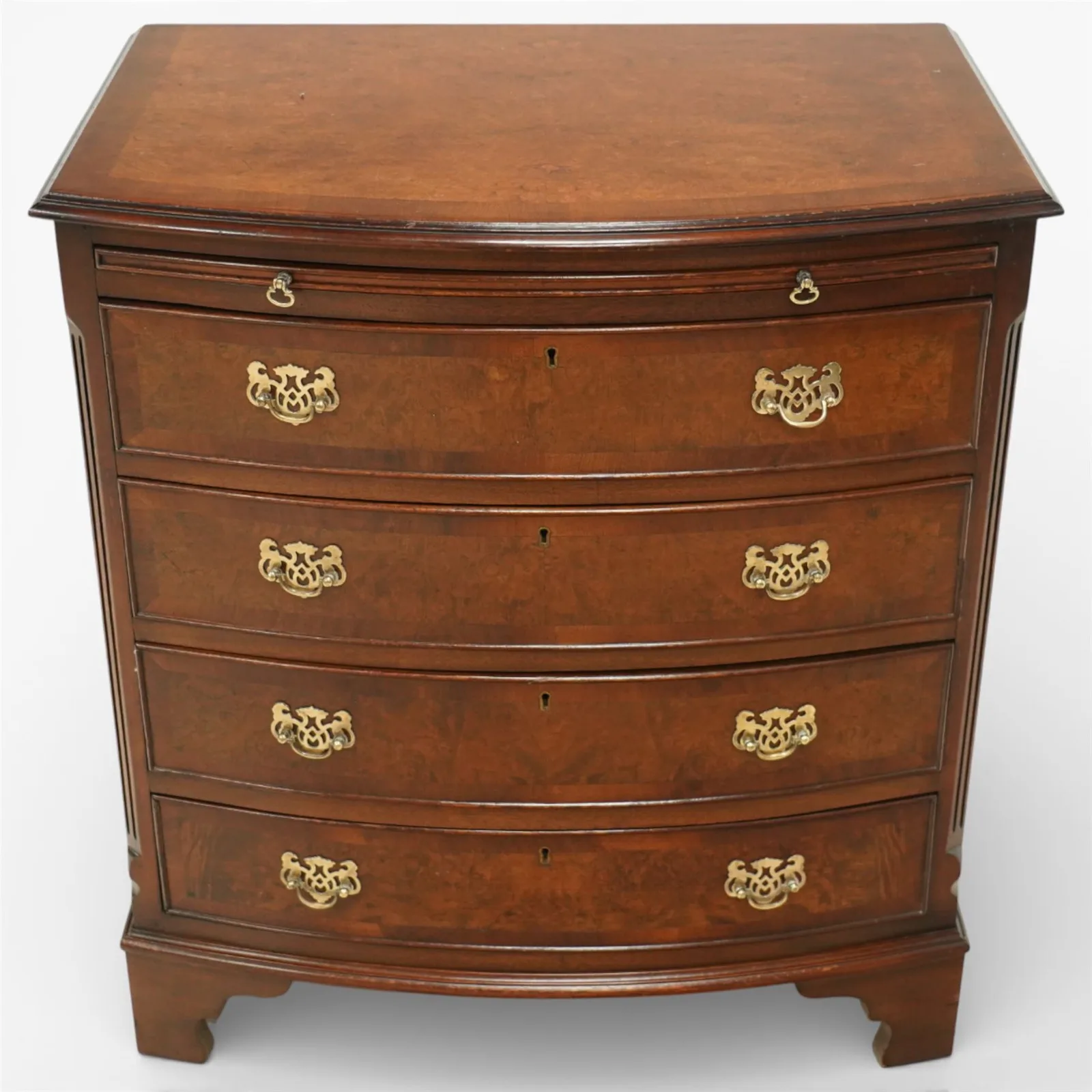
20th century Queen Anne style burr walnut bow fronted chest of drawers, moulded rectangular top above a brushing slide, four graduated drawers fitted with pierced brass handles, flanked by canted corners, raised on shaped bracket feet
A well-proportioned 20th-century chest of drawers conceived in the Queen Anne manner, notable for its richly figured burr walnut surfaces and gently bow-fronted façade. The moulded rectangular top is set above a practical brushing slide, over four graduated drawers fitted with pierced brass handles. The case is articulated by canted front corners and stands on shaped bracket feet, lending the piece a poised, architectural presence. Its compact scale and considered detailing recommend it equally for bedroom or dressing-room use, while the calm symmetry of the drawer fronts and the refined hardware reinforce a restrained, courtly character. The whole presents an appealing dialogue between 18th-century design vocabulary and later revival craftsmanship.
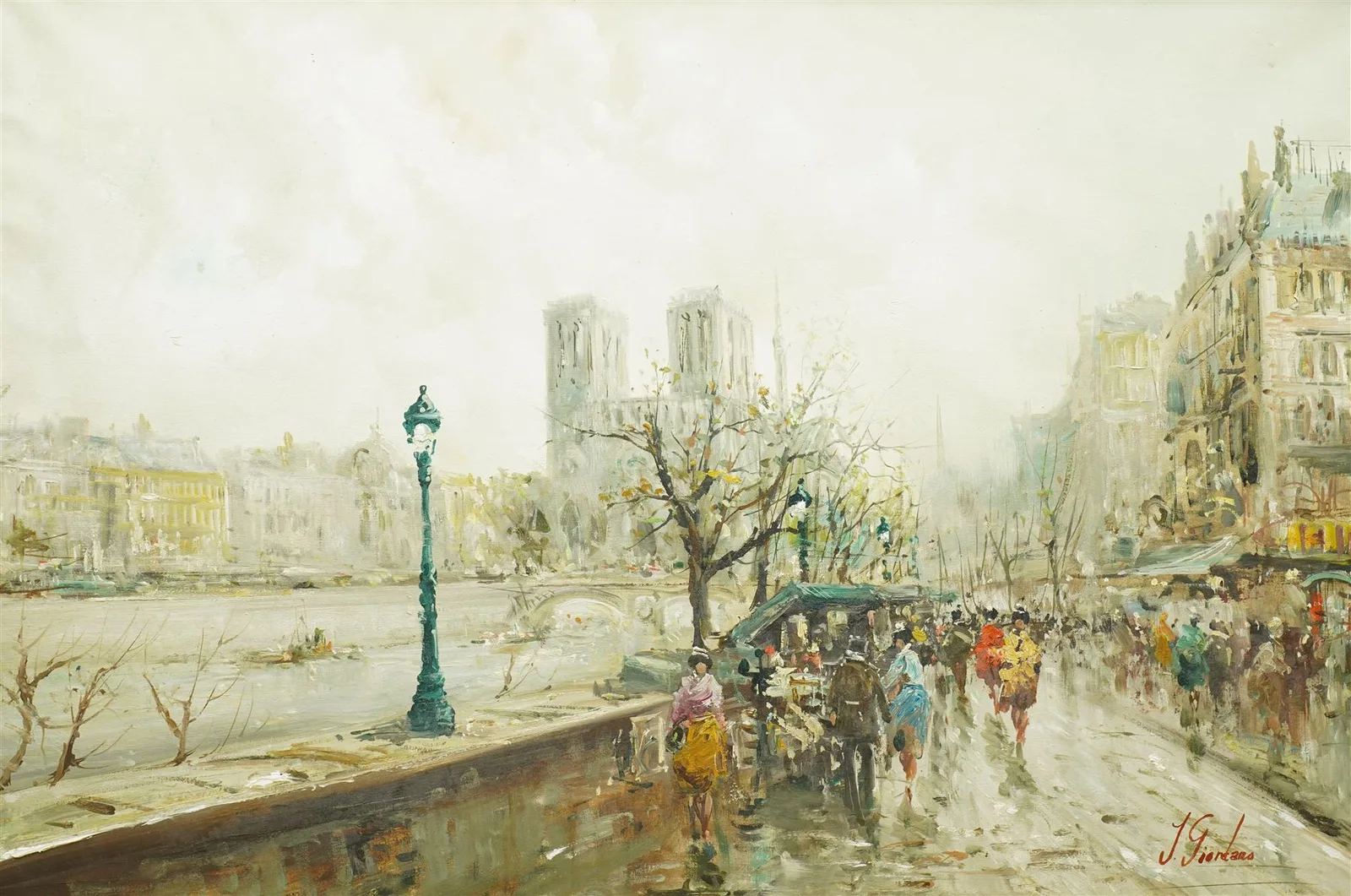
French School (Mid-20th century): Parisian Street Scene, oil on canvas signed J Giordans 60cm x 91cm
An urban genre painting of the French School, mid-20th century, depicting a Parisian street scene in oil on canvas and signed J. Giordans. Executed in a broad horizontal format (approximately 60 x 91 cm), the work presents an animated city view consonant with the enduring appeal of Paris as subject. The composition’s emphasis on architecture and thoroughfare activity aligns with postwar tastes for accessible, representational scenes suitable for domestic display. While the painter has not been firmly identified beyond the signature, the picture exemplifies the period’s market for evocative cityscapes, combining a clear narrative subject with a modern sensibility. A succinct, decorative painting that sits comfortably within the mid-century French School tradition of urban views.
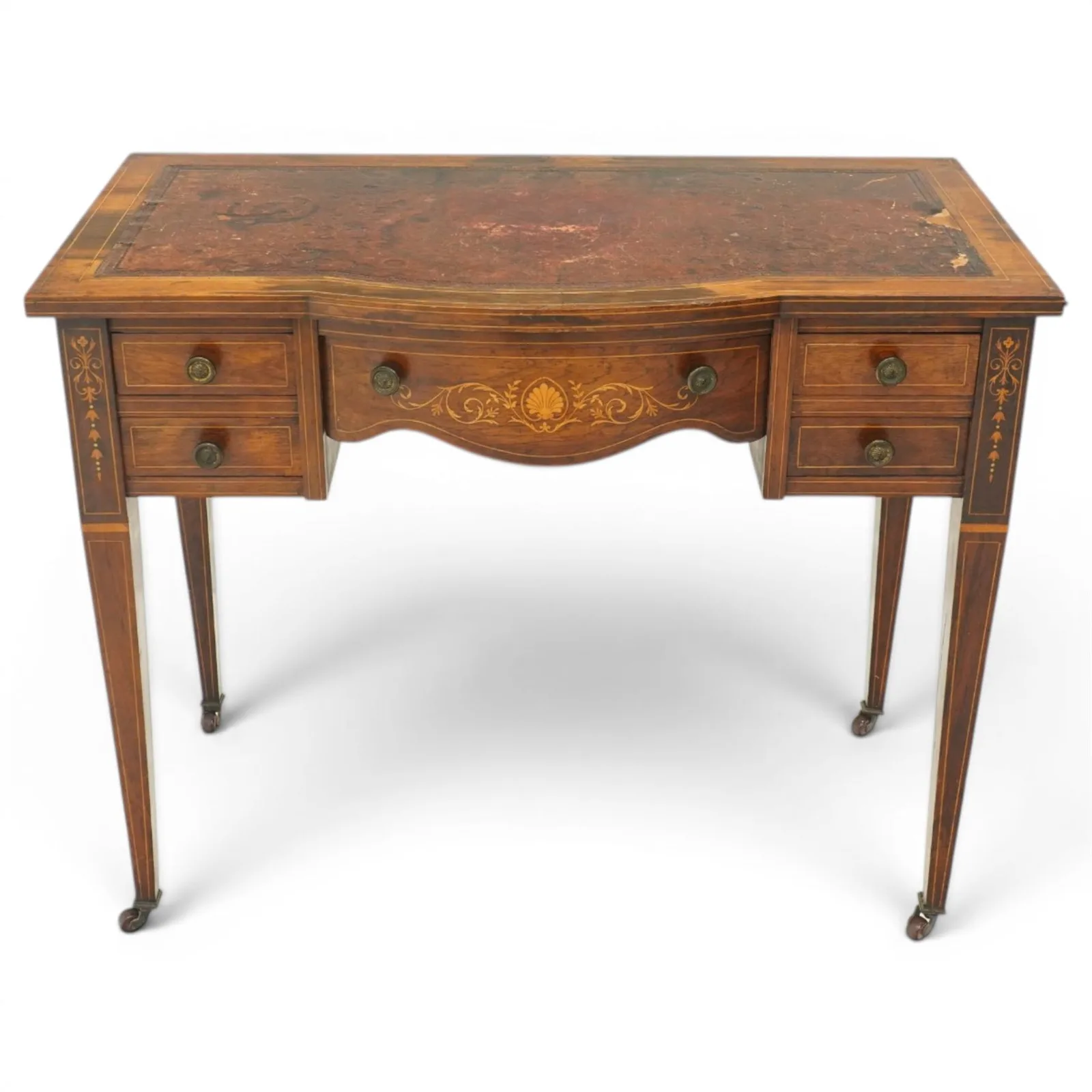
19th century inlaid mahogany bow-front writing table, rectangular shaped top with inset read leather writing surface and satinwood stringing, fitted with single bowfront frieze drawer decorated with scallop shell and trailing foliate motifs, flanked by two drawers to each side, the uprights inlaid with bellflowers, terminating to square tapering supports with ceramic castorsProvenance: Kirkham Hall
A compact 19th-century bow-front writing table in inlaid mahogany, the rectangular top with an inset red leather writing surface framed by fine satinwood stringing. The frieze is organised around a central bow-front drawer enriched with scallop-shell and trailing foliate ornament, flanked by pairs of smaller drawers to each side, offering practical storage. The uprights are detailed with pendant bellflower inlay, and the piece stands on square tapering supports terminating in ceramic castors for mobility. Of modest, versatile proportions (H 74 × W 92 × D 49 cm), the table combines utility with restrained neoclassical refinement in the Sheraton manner. Provenance: Kirkham Hall.
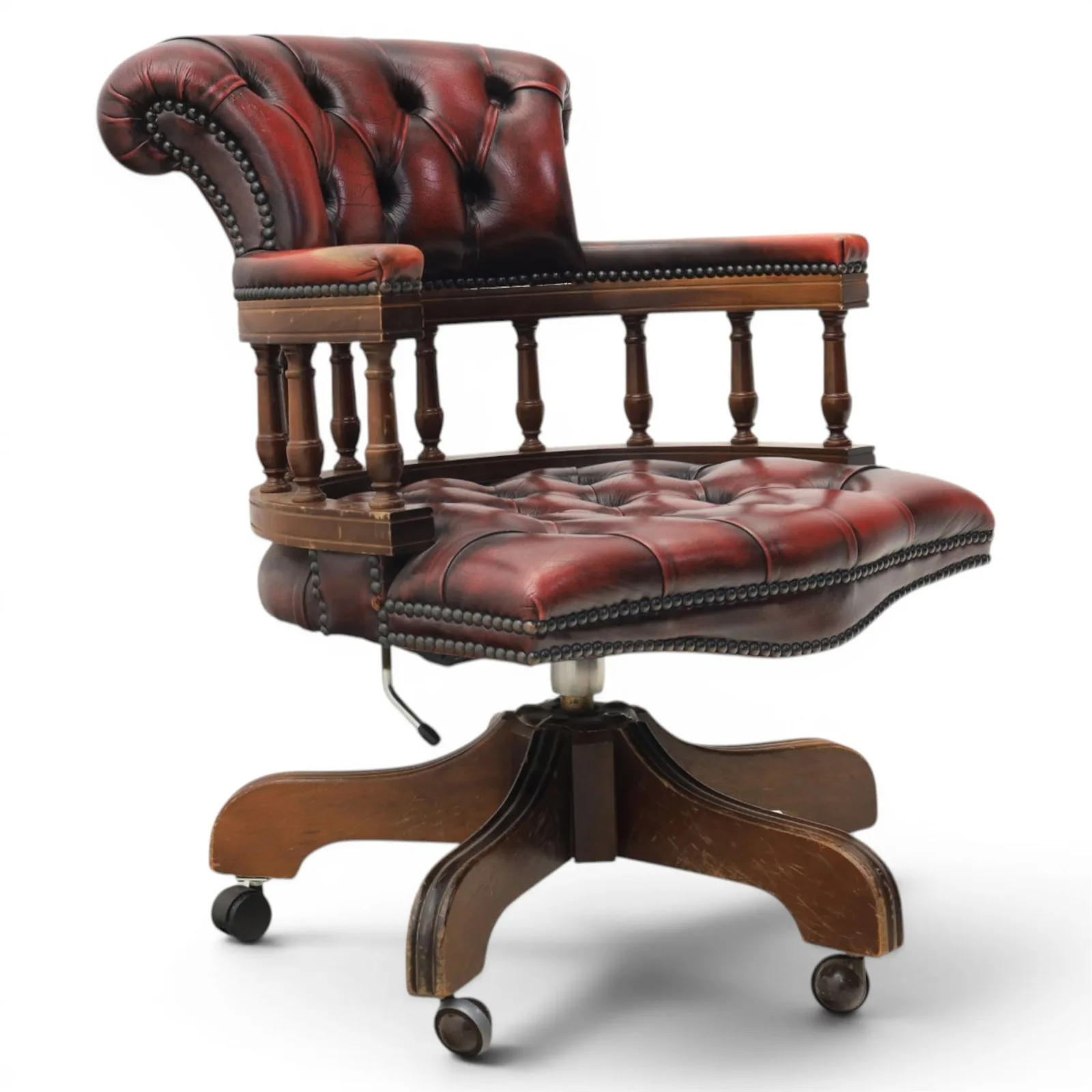
Captains swivel desk chair upholstered in oxblood leather, buttoned back and seat, shaped arm bow raised on turned spindles, five spoke base raised on castors
A traditional Captain’s swivel desk chair upholstered in oxblood leather, with deep buttoning to the back and seat. The enveloping, shaped arm bow is supported on a gallery of turned spindles, providing a continuous, low-back profile characteristic of the type. A five-spoke base with castors facilitates smooth movement, while the central swivel mechanism allows rotation at the desk. The combination of tactile leather upholstery and a timber frame with lathe-turned elements gives the chair both presence and comfort. At 85 cm high and 61 cm wide, it is compact yet substantial, offering practical office seating with a time-honoured appearance suited to a study or library setting.
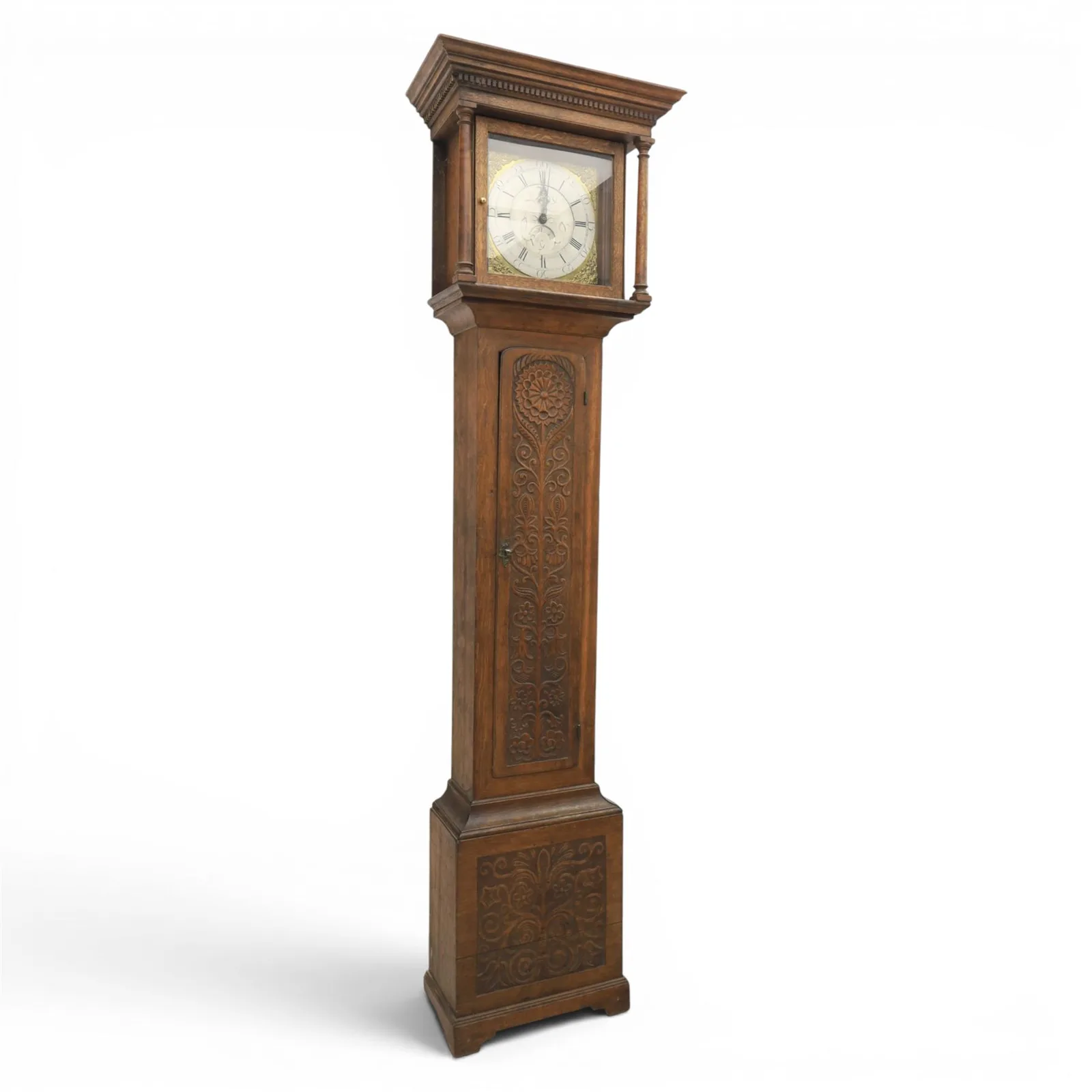
18th century 30 hours oak longcase clock, brass and silvered dial signed Will Snow
An 18th-century longcase clock of 30-hour type, the oak-cased example rising to 210 cm and fitted with a brass dial incorporating silvered elements, signed on the dial ‘Will Snow’. The proportions are modest and practical, with a restrained case that would have suited domestic settings. The 30-hour movement format indicates a weight-driven train intended for daily winding, a configuration widely encountered in provincial clockmaking of the period. The signed dial provides a valuable point of reference for further research into the maker, while the materials and straightforward presentation suggest a serviceable timekeeper typical of its era. An honest, functional example with clear historical utility and quietly traditional character.
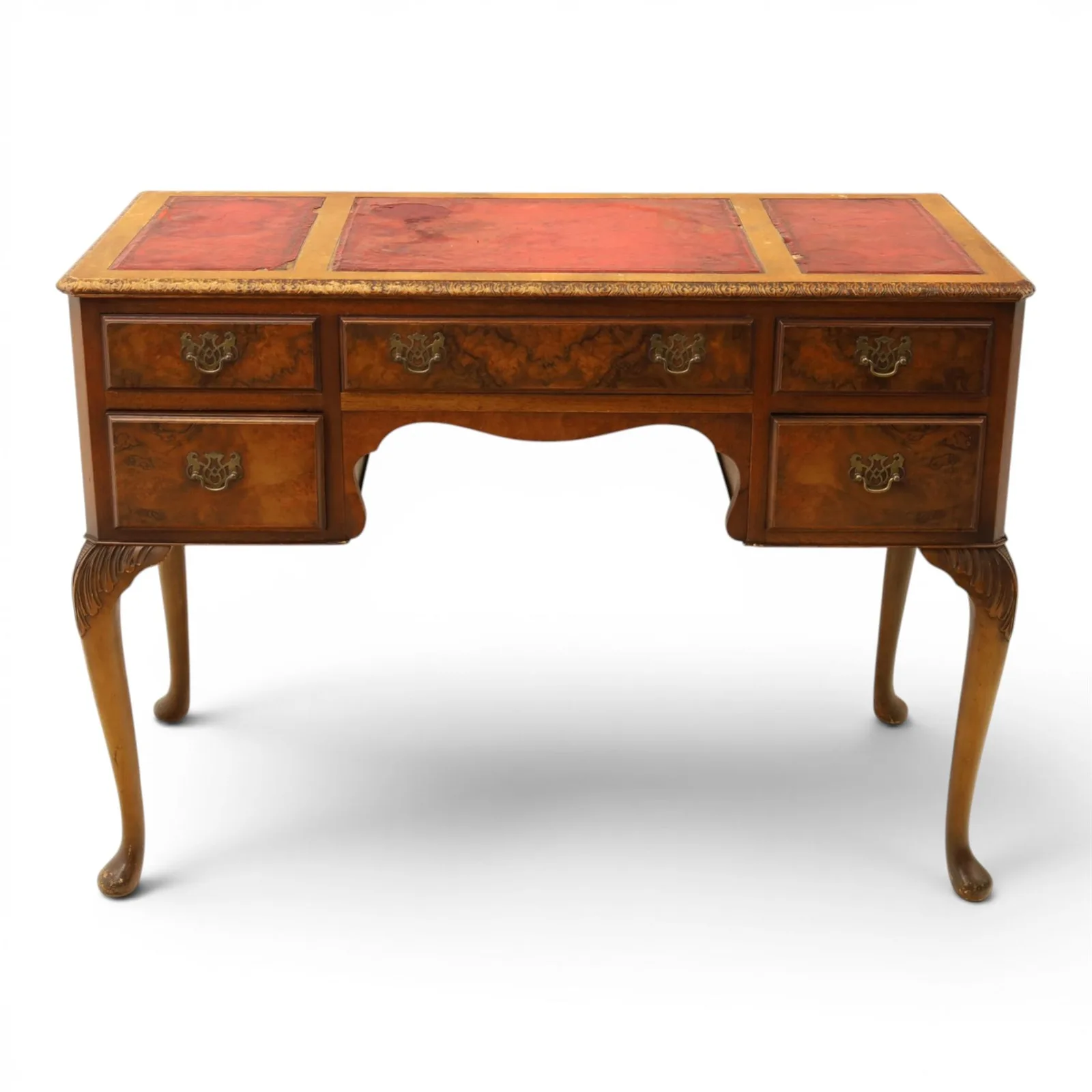
Early 20th-century Queen Anne Revival figured-walnut desk with triple inset leather writing surfaces, five drawers, and graceful proportions
Early 20th-century writing desk of Queen Anne design, the rectangular top set with a triple inset leather writing surface above a frieze fitted with five drawers. Executed in figured walnut, the piece presents a warm, lively grain that animates its restrained, revival silhouette. The configuration offers practical, well-ordered storage while preserving a compact footprint suitable for a refined interior. An understated interpretation of the Queen Anne taste, it balances functionality with decorative appeal through the interplay of figured veneers and the tactile presence of leather. The desk demonstrates the period’s interest in historicist forms reimagined for modern use, and remains a serviceable, elegant furnishing of modest scale.