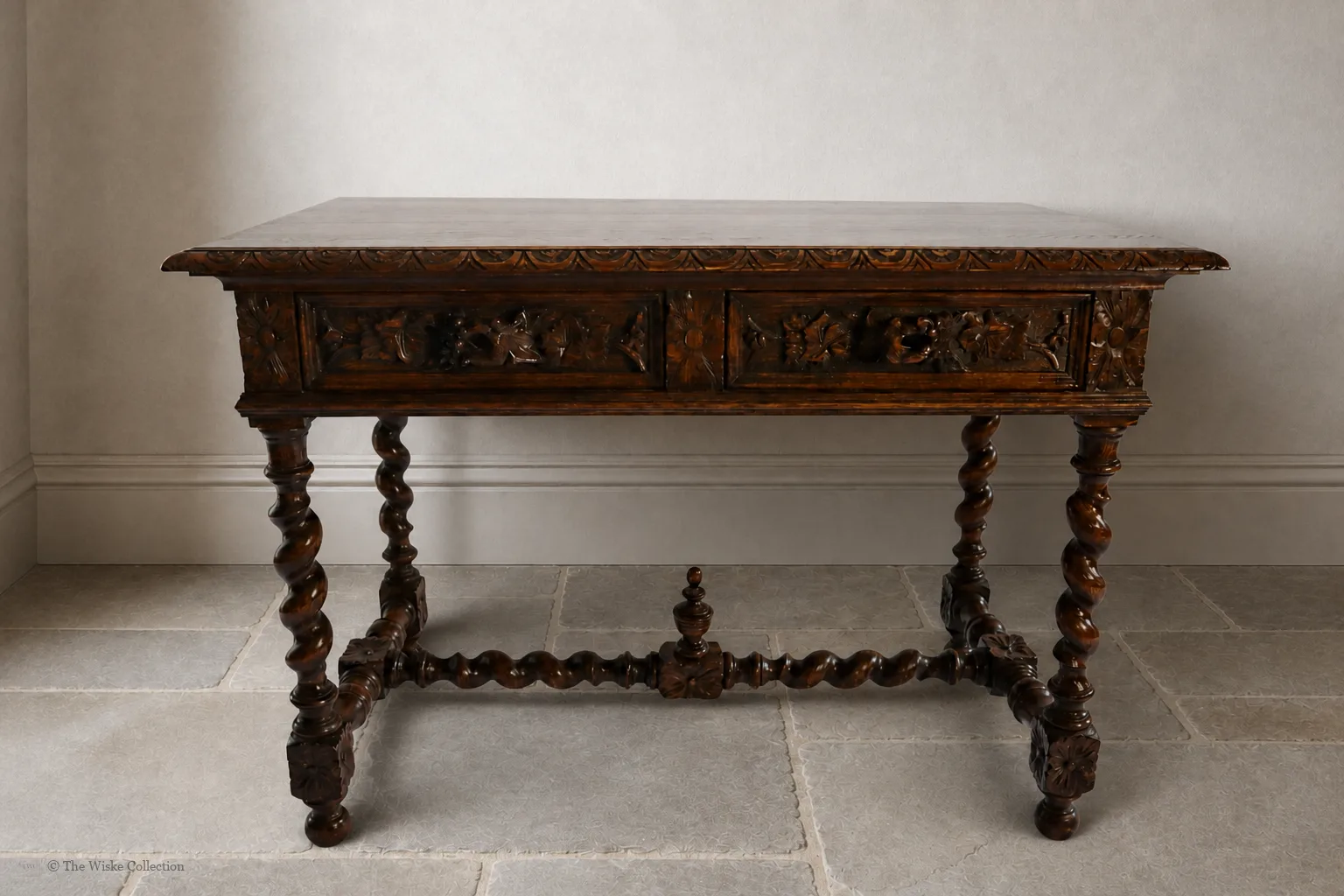
This carved oak side table exemplifies the Victorian engagement with historicist design, drawing particularly on early 17th-century prototypes associated with the Jacobean tradition. The solid, rectangular top—eschewing veneer—speaks to durability and daily use, its moulded and foliate-carved border framing the surface with a disciplined yet lively enrichment. Below, a deep frieze incorporates two drawers, their fronts crisply carved with foliage, symmetrically arranged around a central fixed panel. The visual emphasis on a strong horizontal band of ornament recalls the authoritative friezes of earlier joined furniture while accommodating modern storage needs.
The support is characterised by four barley-twist legs, a quintessential revival motif that reinterprets the spiralled turnings of 17th-century joinery. These are tied by a shaped stretcher centred with a turned knop—both a stabilising device and a decorative punctuation—terminating in straightforward block feet that ground the composition. The combination of dense carving, assertive turning, and clear structural geometry reflects a Victorian preference for materially expressive oak and a legible, architectonic silhouette.
Functionally, the piece operates as a capacious side table, the drawers suited to small accoutrements while the top offers a generous surface. In period settings, such tables were commonly deployed in halls, libraries, or dining spaces, where their historicising language signalled solidity, lineage, and taste. The present example’s balance of carved detail and open understructure avoids heaviness, allowing light to play through the twists and stretcher contours.
Within the broader context of 19th-century revivalism, this table sits comfortably in the Jacobean Revival, a strand that favoured oak, foliate carving, pronounced mouldings, and spiral turnings. Its constructional vocabulary—carved frieze, barley-twist legs, and knopped stretcher—aligns with published exemplars of the period that sought to mediate between past forms and contemporary domestic requirements. The result is a practical furnishing whose decorative programme is integral rather than applied, embodying the Victorian ambition to fuse historical reference with everyday utility.
Victorian carved oak side table with solid moulded and carved rectangular top, deep frieze of foliate-carved twin drawers flanking a central panel, on barley-twist legs united by a shaped stretcher with turned knop, ending in block feet
A robust Victorian carved oak side table of Jacobean Revival character, the solid rectangular top enclosed by a moulded and leaf-carved border above a deep frieze configured with two foliate-carved drawer fronts flanking a central fixed panel. The support is provided by four boldly barley-twist legs united by a shaped stretcher centred by a turned knop and resting on block feet. Combining utility with decorative presence, the table’s emphatic turnings and carved ornament animate an otherwise rectilinear form. Well-proportioned and of practical scale, it would have served as a versatile ancillary surface while projecting a consciously historicising aesthetic typical of late 19th-century taste.