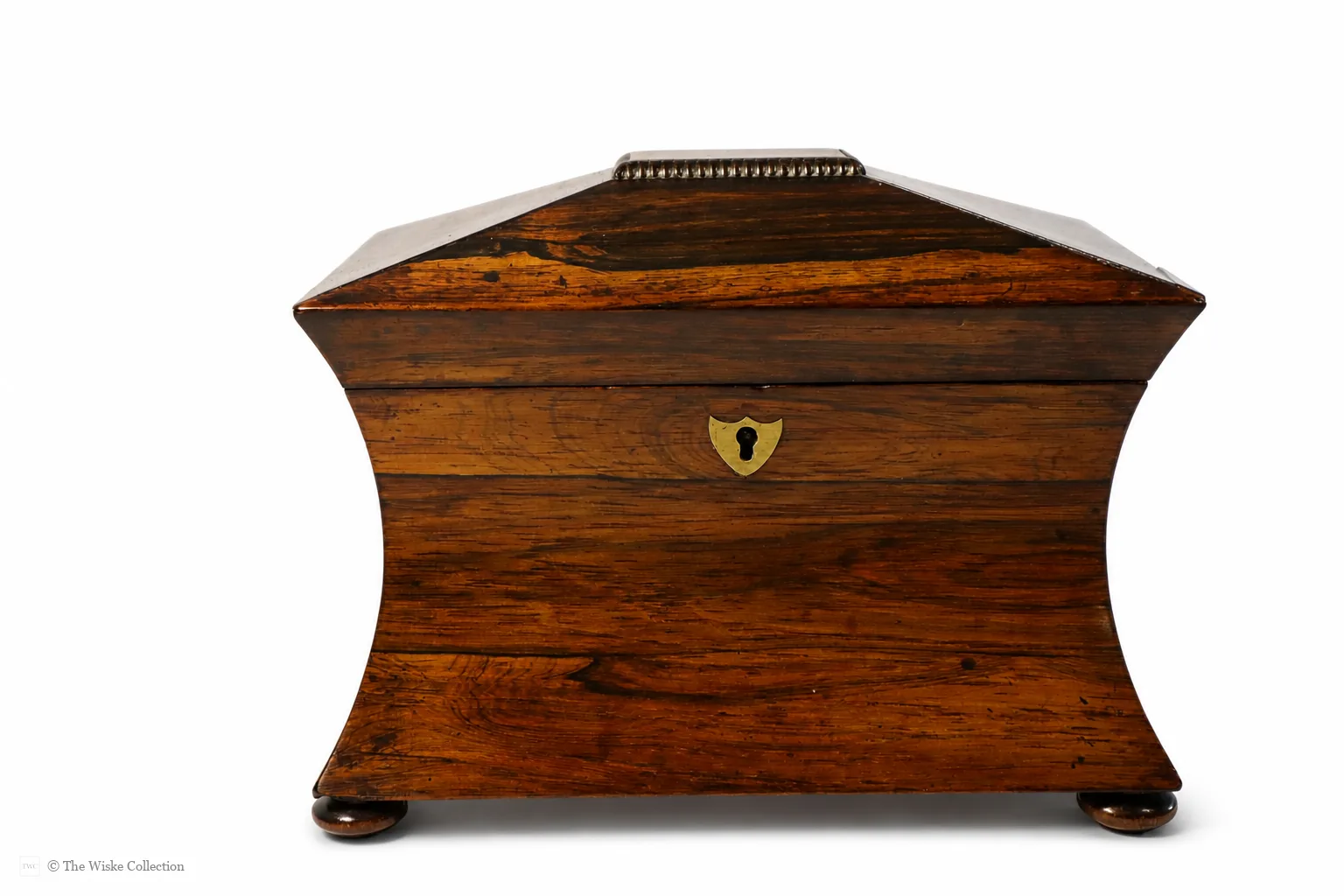
This small casket-form tea caddy exemplifies the early nineteenth-century predilection for classically derived shapes translated into elegant household objects. The waisted sarcophagus profile—here defined by concave sides below a flat, rectangular lid—derives from antiquity and became a favored vocabulary for caddies and cellarets of the period. The restrained exterior is enlivened chiefly by the richly grained rosewood and a discreet brass keyplate, the latter signalling the valued nature of the contents and the importance of controlled access within the domestic setting.
Set on four compressed bun feet, the caddy is visually lifted from the surface on which it stands, the turned elements providing a measured counterpoint to the planar sides. Within, the twin-compartment arrangement follows common practice, facilitating the separation of different teas—often black and green—at a time when tea remained both costly and central to polite sociability. While specific interior finishes are not recorded for this example, comparable caddies of the period frequently incorporate removable lids and protective linings to preserve freshness and aroma, underscoring the object’s functional sophistication.
Rosewood was particularly esteemed in the early nineteenth century for its luxuriant figure and depth of color, and its use here aligns the piece with the broader neoclassical taste that favored fine veneers and clear architectural outlines over overt ornament. The carefully judged proportions and crisp silhouette allow the timber’s natural qualities to take precedence, while the brass escutcheon introduces a note of gleam without disturbing the overall restraint.
Though lacking a maker’s mark or documented provenance, the caddy’s form and materials place it securely within early nineteenth-century practice in Britain and on the Continent, where such containers were essential accessories to the tea table or sideboard. As a compact yet eloquent expression of domestic refinement, the present example illustrates the confluence of utility, security, and classical styling that characterizes the period’s best small boxes and caddies.
Early 19th-century rosewood tea caddy of waisted sarcophagus form, with twin compartments, brass keyplate, and compressed bun feet; 17cm high, 22cm wide
Early 19th century rosewood tea caddy of waisted sarcophagus form, the rectangular lid rising above a gently concave body and resting on four compressed bun feet. The exterior is understated and refined, with the warm figure of the rosewood uninterrupted save for a neatly set brass keyplate to the front. The interior, arranged with twin compartments, reflects the period convention of storing different teas separately. Of compact, table-top scale (approximately H 17cm, W 22cm), the piece combines classical taste with practical function, its poised proportions and crisp outline characteristic of the era’s disciplined aesthetic. A finely made domestic container expressive of the social importance of tea in the early nineteenth century.