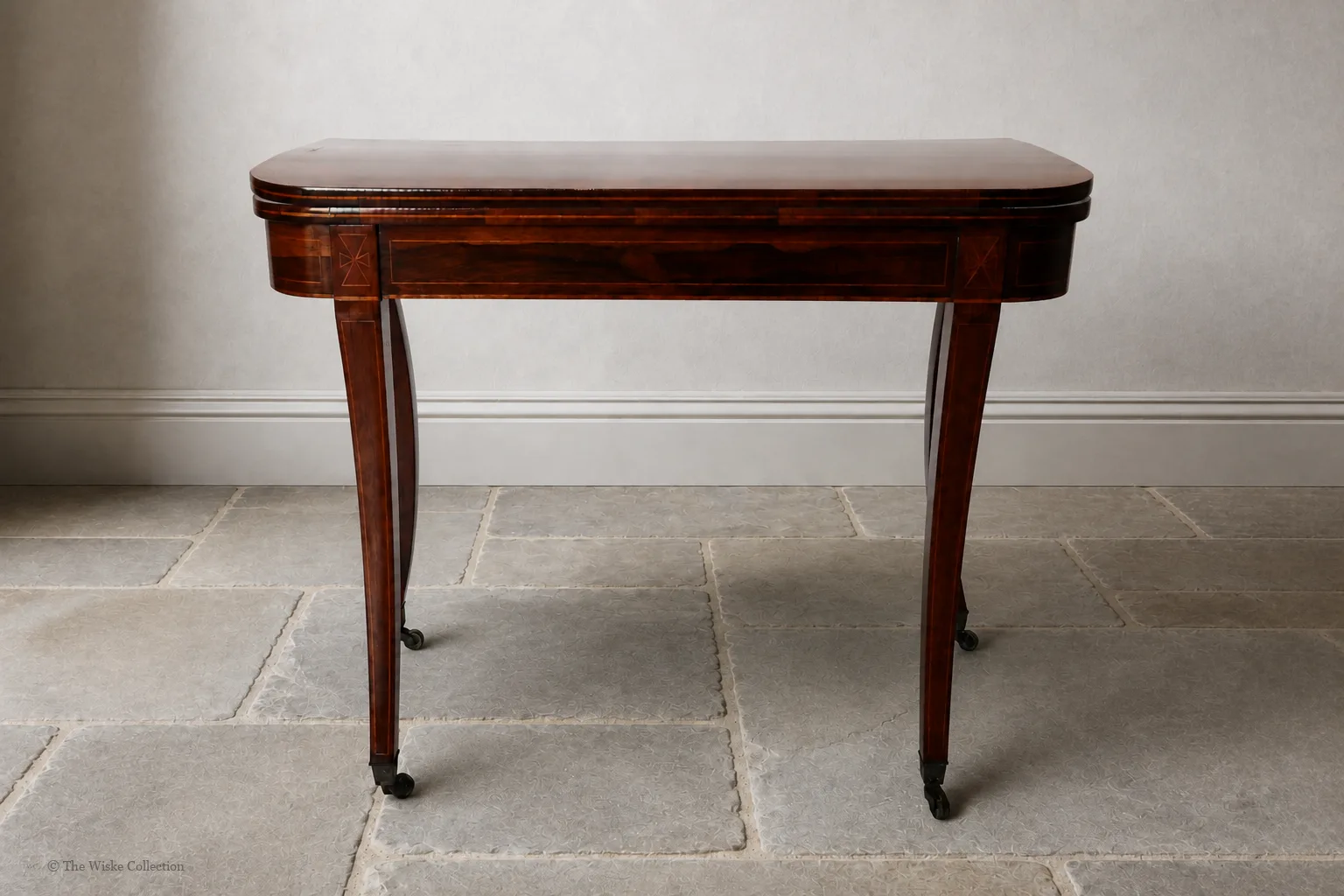
This early 19th-century folding tea table presents a disciplined harmony of form and veneer, characteristic of refined domestic furnishings of the period. The rounded rectangular top is distinguished by satinwood banding that crisply articulates the perimeter, set against the darker rosewood ground. The frieze is crossbanded, a deliberate play of veneer direction that enlivens the surface while maintaining the table’s overall sobriety. Such controlled contrast—light satinwood edging against rosewood—was favoured for its clarity and durability at the edges most susceptible to wear.
The hinged fold-over mechanism allows the top to double in depth for tea service, then return to a compact stance when not in use. While the listing does not specify the internal support, such tables commonly relied on a simple swing or similar device to bear the opened leaf—an expedient, unfussy solution consistent with the table’s functional discretion. The tapered square supports are unadorned and direct, their attenuated geometry reinforcing the restrained silhouette. Brass castors provide ease of movement across carpets and hard floors alike, acknowledging the social practicality of shifting furniture to accommodate changing patterns of use.
In material terms, the choice of rosewood underscores an early 19th-century preference for dense, richly figured veneers capable of a deep polish and visual depth. The satinwood banding, precisely applied, functions both as ornament and as a crisp boundary to the top. The crossbanded frieze signals accomplished veneering practice, its transverse grain subtly catching the light and emphasizing the table’s horizontals. The overall effect is elegant but not ostentatious, aligning with a neoclassical sensibility that prized balanced proportion and refined surface treatment over heavy carving.
As a type, folding tea tables occupied an essential niche: compact when idle, generous when required, and sufficiently portable to be repositioned as the household rhythm demanded. The present example’s measured detailing, practical hinge action, and castored legs place it securely within early 19th-century taste, offering a poised synthesis of utility and decorative finish suitable for formal service and everyday sociability alike.
Beautiful Regency rosewood folding tea table, early 19th century, rounded rectangular top with satinwood banding and crossbanded frieze; hinged fold-over action; raised on tapered square supports with brass castors
An early 19th-century folding tea table in rosewood, the rounded rectangular top defined by satinwood banding and a neatly crossbanded frieze. Conceived for compact elegance, the hinged fold-over action allows the top to double in size for service, then return to a discreet console-like profile. The table is raised on tapered square supports terminating in brass castors, combining refinement with practical mobility. The restrained ornament, contrasting veneers, and clean geometry suggest a tasteful, neoclassically inflected aesthetic of the period. Well-proportioned and versatile, this example typifies the polite domestic ritual of tea, marrying surface richness in fine veneers with economical, well-resolved construction.