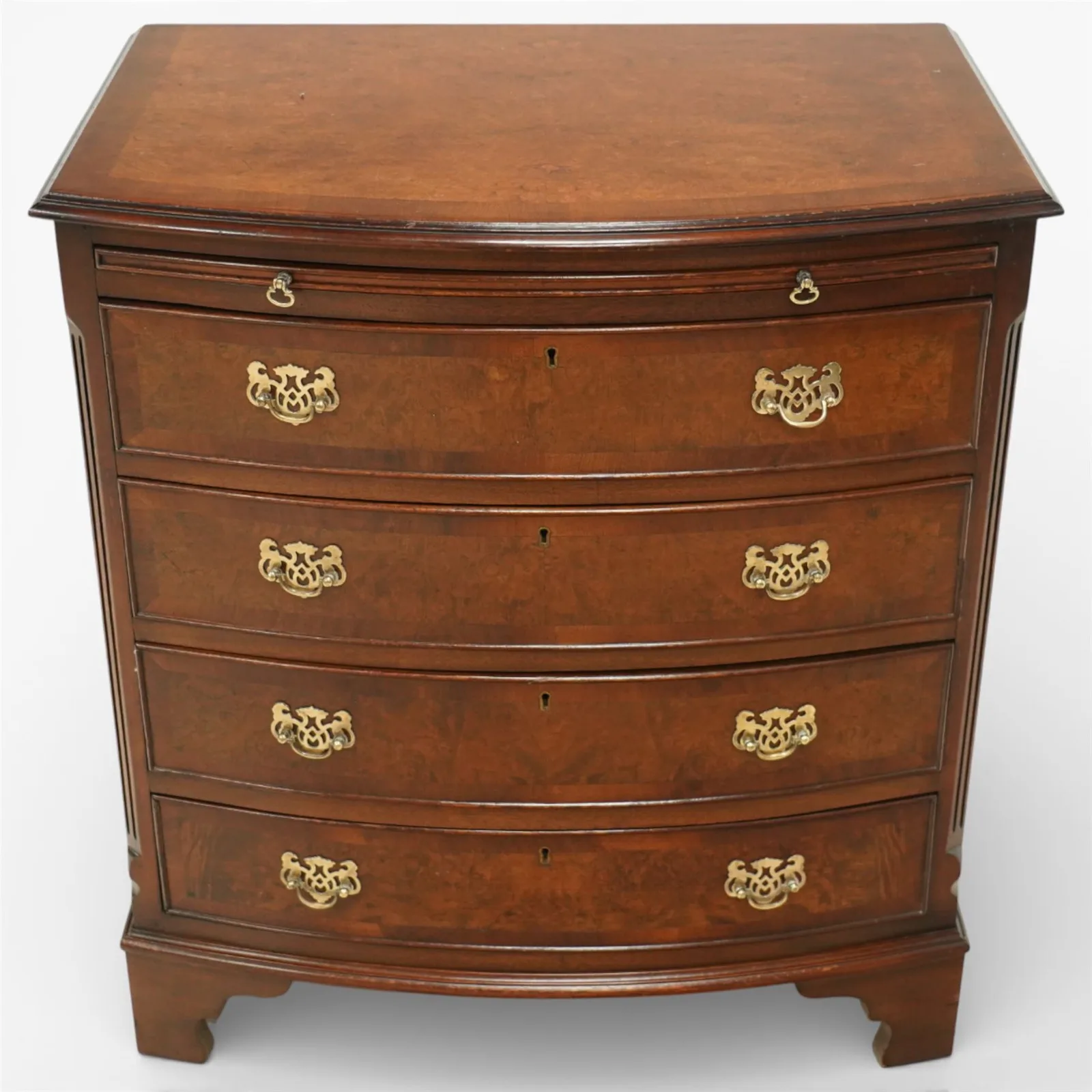
This bow-fronted chest of drawers interprets the Queen Anne idiom for a 20th-century audience, combining an emphasis on balanced proportion with a preference for warm, figured walnut surfaces. The façade progresses in a gentle convex arc, a device that softens the outline and offers a pleasing alternation of light across the burr figuring. A moulded rectangular top establishes the architectural line, and a neatly concealed brushing slide beneath provides a practical pull-out surface for laying garments or preparing attire, a convenience that recalls early 18th-century dressing furniture and bureau interiors.
The drawer arrangement is classically ordered, with four graduated drawers that subtly increase in depth toward the base, promoting both visual stability and useful storage. Pierced brass handles supply a crisp, reflective counterpoint to the timber, their openwork enhancing the sense of lightness across the bow-front. Canted corners refine the verticals of the case, avoiding abrupt edges while echoing period cabinetmaking conventions. The whole is raised on shaped bracket feet, a characteristic support associated with the Queen Anne and early Georgian canon, which affords steadiness and elevates the carcass with measured grace.
While its vocabulary draws upon early 18th-century prototypes—walnut surfaces, bracket feet, discreet molding—the bow-fronted profile converses with later Georgian taste, exemplifying the selective hybridization typical of 20th-century historicist production. The result is a piece that is at once decorous and functional, scaled for domestic versatility and composed with disciplined restraint. The burr walnut contributes animated figure and tonal depth, improving the play of light across the façade and anchoring the chest’s visual interest without recourse to excessive ornament.
As a practical object, the chest offers adaptable storage within its graduated drawers, and the brushing slide extends its utility beyond simple containment. The measured silhouette, coherent detailing, and considered materials align it with quality revival craftsmanship, presenting a dignified furnishing that acknowledges earlier models while meeting modern requirements of space and use.
20th century Queen Anne style burr walnut bow fronted chest of drawers, moulded rectangular top above a brushing slide, four graduated drawers fitted with pierced brass handles, flanked by canted corners, raised on shaped bracket feet
A well-proportioned 20th-century chest of drawers conceived in the Queen Anne manner, notable for its richly figured burr walnut surfaces and gently bow-fronted façade. The moulded rectangular top is set above a practical brushing slide, over four graduated drawers fitted with pierced brass handles. The case is articulated by canted front corners and stands on shaped bracket feet, lending the piece a poised, architectural presence. Its compact scale and considered detailing recommend it equally for bedroom or dressing-room use, while the calm symmetry of the drawer fronts and the refined hardware reinforce a restrained, courtly character. The whole presents an appealing dialogue between 18th-century design vocabulary and later revival craftsmanship.