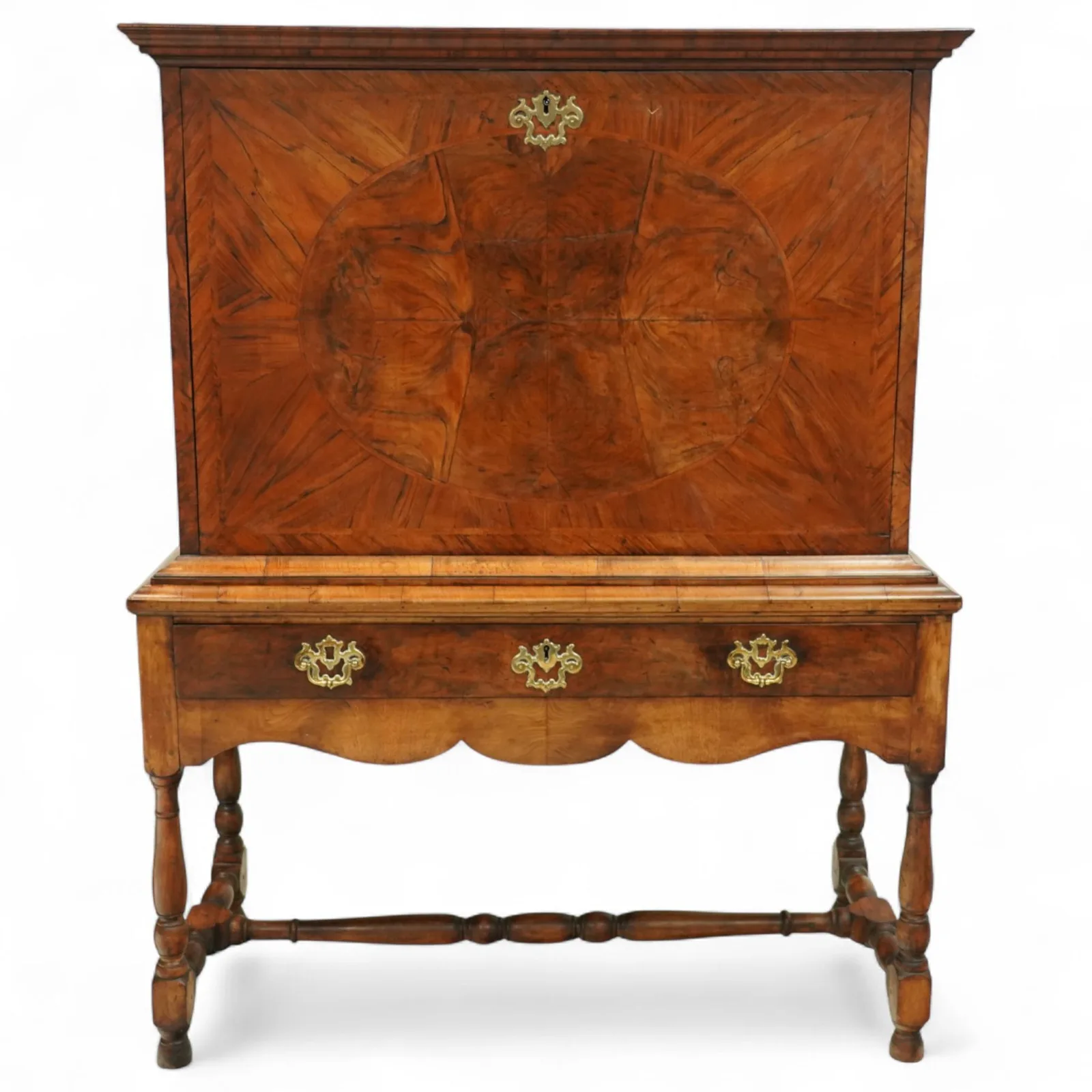
This early 18th-century walnut bureau cabinet conforms to the George I preference for refined veneers and compact, efficient writing furniture. The projecting, moulded cornice asserts a cabinetmaker’s concern for architectural silhouette, while the fall-front is distinguished by an oval burr-walnut reserve, a decorative device prized for its animated figuring and tonal depth. Within, the fitted arrangement of small drawers, pigeonholes and a cupboard reflects established writing practices of the period, providing ordered storage for correspondence, documents and personal effects. The baize-lined writing surface offers a softened, practical plane, its material choice typical of the period’s concern for both legibility and preservation of writing instruments.
Externally, the carcase and fall are faced in figured walnut, with the burr-veneered oval set against straighter grain to heighten contrast. Below the writing compartment a long drawer extends the functional capacity, continuing the unified façade when the bureau is closed. The cabinet is now raised on a later stand with turned legs and a stretcher, visually lightening the mass of the upper section and offering a measured, furniture-historical dialogue between early 18th-century veneered casework and subsequent base fashions. Brass strut supports have been introduced to stabilise the stand, a practical intervention noted here for completeness. The key is lacking.
In form and detail, the piece situates comfortably within early Georgian taste, when walnut—particularly burr—was favoured for its decorative potential on bureau and cabinet fronts. The restrained ornament, reliance on clean architectural mouldings, and carefully managed veneer fields align with the late Baroque current in domestic cabinetmaking. While the later stand alters the original silhouette, the ensemble preserves the object’s principal historical interest: a well-conceived writing cabinet whose interior fittings and veneered fall-front encapsulate the period’s synthesis of utility and surface refinement.
George I walnut bureau cabinet, early 18th century; moulded cornice, fall-front inlaid with oval burr-walnut panel, fitted drawers, pigeonholes and cupboard; baize-lined writing surface above long drawer; apron, turned legs and stretcher; later stand with brass strut supports; lacking key
A George I walnut bureau cabinet of early 18th-century date, the superstructure with a moulded cornice above a fall-front inlaid with an oval burr-walnut panel. The interior is fitted with small drawers, pigeonholes and a cupboard, the writing surface lined in baize and set over a long drawer. The carcass presents a pleasing warmth and figured veneer, its profile now elevated on a later stand with turned legs and a box stretcher, further strengthened by brass strut supports. Of practical proportions, the piece combines refined surface treatment with a well-organised writing interior. The key is lacking.